|
 |
 |
 |
 |
 |
 |
 |
 |

 |
How Cooperation Can Evolve in a Cheater's World
Providence RI (SPX) Jul 03, 2006 It's a truth borne out in biology and economics: Selfishness pays. Viruses can steal enzymes to reproduce. Tax evaders can take advantage of public services to survive and thrive. And, according to game theory, the cheats win out over the altruists every time. Yet cooperation is a hallmark of human society, allowing for the creation of everything from the local grange to the United Nations. Cooperation can also be found in the animal world. Lions hunt in packs. Ants and bees create colonies. So how could cooperation evolve in a cheater's world? It's a paradox called the "tragedy of the commons," a conflict between individual interests and the common good that has stumped scientists for generations. Now a trio of researchers, including a Brown University biologist, has created a unique theoretical model that can explain the rise of cooperation. Under their model, altruists not only survive, they thrive and maintain their numbers over time. The work appears in the Proceedings of the Royal Society B: Biological Sciences. "What's exciting about our approach is that is so simple and so general - in principle it can be applied to explain cooperation at all levels of biological complexity, from bugs to humans," said Thomas Flatt, a postdoctoral research associate in Brown's Department of Ecology and Evolutionary Biology. "It's also exciting because cooperation is a critical notion in so many disciplines, from biology to sociology. Yet its existence and persistence doesn't always make sense. Now we have a new mechanism that explains when cooperation can work." Timothy Killingback, a mathematician at the College of William & Mary, led work on the model. It's based on public goods games, a staple of game theory and a simple model of social dilemmas. Under the typical public goods game, an experimenter gives four players a pot of money. Each player can invest all or some of the money into a common pool. The experimenter then collects money thrown into the pool, doubles it and divides it amongst the players. The outcome: If every player invests all the money, every player wins big. If every player cheats by investing a just few dollars, every player reaps a small dividend. But if a cooperator squares off against a cheater - with the altruist investing more than the swindler - the swindler always gets the bigger payoff. Cheating, in short, is a winning survival strategy. Under the new model, the team introduced population dynamics into the public goods game. Players were broken into groups and played with other members of their group. Each player then reproduced in proportion to the payoff they received from playing the game, passing their cooperator or cheater strategy on to their offspring. After reproduction, random mutations occurred, changing how much an individual invests. Finally, players randomly dispersed to other groups, bringing their investment strategies with them. The result was an ever-changing cast of characters creating groups of various sizes. After running the model through 100,000 generations, the results were striking. Cooperators not only survived, they thrived and maintained their numbers over time. The key is group size. "In our model, you can get groups of different sizes - and cooperators seem to flourish in smaller groups," Flatt said. "In these smaller groups, the high investments of cooperators begin to pay off. Cooperators have a higher level of fitness, so they reproduce at higher rates. This allows them to get a toehold within a group, then dominate it, then send their offspring to spread their altruism elsewhere." The model created by Killingback, Flatt, and Jonas Bieri, a Swiss population biologist and computer programmer, is unlike any other. It relies solely on population dynamics to explain the evolution of cooperation. Most other models assume more complicated mechanisms such as kin selection, punishment and reciprocity. Some of those mechanisms require cognition, so those models can only be applied to humans and higher-order animals. Community Email This Article Comment On This Article Related Links - Darwin Today At TerraDaily.com
 Scientists Puzzled By Sand Bacteria
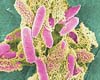 Mount Pleasant (UPI) Jun 30, 2006
U.S. scientists say bacteria forcing the closure of many beaches may not be coming from people, animals, or sewage -- but might be produced in the sand. Researchers at Central Michigan University say they have found E. coli can live and thrive in beach sand without a warm-blooded host. |
|
|

| The content herein, unless otherwise known to be public domain, are Copyright 1995-2006 - SpaceDaily.AFP and UPI Wire Stories are copyright Agence France-Presse and United Press International. ESA PortalReports are copyright European Space Agency. All NASA sourced material is public domain. Additionalcopyrights may apply in whole or part to other bona fide parties. Advertising does not imply endorsement,agreement or approval of any opinions, statements or information provided by SpaceDaily on any Web page published or hosted by SpaceDaily. Privacy Statement |