|
 |
 |
 |
 |
 |
 |
 |
 |

 |
Hot And Heavy Dinos Rules The Earth
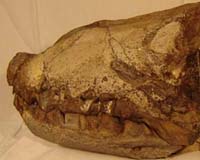
Gainesville FL (SPX) Jul 13, 2006 If you think dinosaurs are hot today, just think back to about 110 million years ago when they really ran hot and heavy. One of the larger animals, a behemoth called Sauroposeidon proteles, weighed close to 120,000 pounds as an adult. Now, a new study led by the University of Florida suggests it may have had a body temperature close to 48 degrees Celsius. That is a 118-degree Fahrenheit normal temperature, about as hot as most living creatures can get before the proteins in their bodies actually begin to break down. In fact, the size of the largest dinosaurs may ultimately have been limited by their body temperatures, according to a team of scientists from the UF Genetics Institute, the National Center for Ecological Analysis and Synthesis in Santa Barbara and the University of New Mexico writing this week in the online journal PLoS Biology. One of the first things to strike me about our results was that larger dinosaurs, for their size, were much more active than contemporary reptiles, said Andrew Allen, a researcher with the NCEAS. If these animals functioned at temperatures of 35 or 40 degrees centigrade, it suggests that they operated at a rate more like today s mammals and birds. While the largest dinosaurs may not have been running around as fast as in Jurassic Park, they certainly were very active given their extreme size. Tyrannosaurus rex, one of the more familiar dinosaurs considered by the researchers, probably had a cruising temperature of about 33 degrees Celsius, which is just over 91 degrees Fahrenheit, according to lead researcher James Gillooly, an assistant professor in UF s department of zoology. Humans have a normal temperature around 98.6 degrees Fahrenheit and redline at about 108 degrees. Researchers determined dinosaur temperatures - long a subject of debate in biology - by combining their understanding of relationships among body size, temperature and growth rates with newly available fossil data on the growth rates of eight dinosaur species. Using a mathematical formula, they produced the first prediction of dinosaur body temperatures based on direct fossil evidence. When a dinosaur started small and grew large, its body temperature changed dramatically through its lifespan, unlike any animals we know today, Gillooly said. It increased by about 5 degrees Fahrenheit for species weighing about 661 pounds as adults and nearly 36 degrees for those reaching about 27 tons. This dramatic difference in body temperature between the largest and smallest dinosaurs probably resulted in major differences in how these species lived, because we know a difference of 18 degrees Fahrenheit results in a nearly 300 percent change in rates of population growth, lifespan and population density. For many years, scientists had assumed that dinosaurs were cold-blooded, or ectotherms, with a slow metabolism that required the sun s heat to regulate temperature. But in the late 1960s, the notion emerged that dinosaurs, like mammals and birds, might have been warm-blooded, or endotherms, with relatively constant, high body temperatures that were internally regulated. The new findings show that even though dinosaurs were cold-blooded reptiles, large dinosaurs dissipated body heat more slowly, and thus maintained higher, more constant body temperatures similar to today s birds and mammals. The researchers show that this increase in body temperature with size has been observed in modern crocodiles. The study is an important contribution to the scientific discussion about dinosaurs, because it is the first that uses evidence directly derived from fossils - rather than from theoretical models - to conclude that many of the larger dinosaurs were indeed warm reptiles, said Frank Seebacher, of the School of Biological Sciences at the University of Sydney, who did not take part in the research. These findings clearly show that mammal-like endothermy is not a necessary prerequisite for ecological success. Dinosaurs inhabited all latitudes, and although the climate in the age of dinosaurs 65 (million) to 150 million years ago was much warmer than today, the animals could nonetheless maintain high body temperatures in polar climates with freezing or near-freezing conditions. The advantages of being a warm reptile are that no energy has to be expended to produce metabolic heat to keep warm; in other words, if we were warm reptile-like ectotherms, we would save a lot of money on the grocery bill. In the meantime, the research team continues to investigate what are proving to be universal relationships among size, growth rate and temperature. There are differences between mammals and invertebrates, but within a group, from a mouse to an elephant, or plankton to a large fish, we have found growth rate can be explained by how warm the animal is and how big the animal is, Gillooly said. If we know the growth rate and size, we can determine temperature. If we know size and temperature, we can make predictions about the rate at which an organism lives and reproduces. This simple little equation has turned out to be tremendously useful to understanding the biological time clock. Community Email This Article Comment On This Article Related Links University of Florida Darwin Today At TerraDaily.com
 Major Initiative Proposed To Address Amphibian Crisis
 Corvallis OR (SPX) Jul 07, 2006
Fifty of the leading amphibian researchers in the world have called for a new Amphibian Survival Alliance, a $400 million initiative to help reduce and prevent amphibian declines and extinctions, an ecological crisis of growing proportion that is continuing to get worse. |
|
|

| The content herein, unless otherwise known to be public domain, are Copyright 1995-2006 - SpaceDaily.AFP and UPI Wire Stories are copyright Agence France-Presse and United Press International. ESA PortalReports are copyright European Space Agency. All NASA sourced material is public domain. Additionalcopyrights may apply in whole or part to other bona fide parties. Advertising does not imply endorsement,agreement or approval of any opinions, statements or information provided by SpaceDaily on any Web page published or hosted by SpaceDaily. Privacy Statement |