|
 |
 |
 |
 |
 |
 |
 |
 |

 |
Homing In On Dark Energy With Supernova Studies In Space
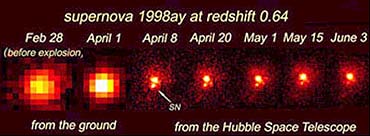
Berkeley - Sep 19, 2003 A unique set of 11 distant Type Ia supernovae studied with the Hubble Space Telescope sheds new light on dark energy, according to the latest findings of the Supernova Cosmology Project, recently posted on the web, and soon to appear in the Astrophysical Journal. Light curves and spectra from the 11 distant supernovae constitute "a strikingly beautiful data set, the largest such set collected solely from space," says Saul Perlmutter, an astrophysicist at Lawrence Berkeley National Laboratory and leader of the Supernova Cosmology Project (SCP). The SCP is an international collaboration of researchers from the United States, Sweden, France, the United Kingdom, Chile, Japan, and Spain. Type Ia supernovae are among astronomy's best "standard candles," so similar that their brightness provides a dependable gauge of their distance, and so bright they are visible billions of light years away. The new study reinforces the remarkable discovery, announced by the Supernova Cosmology Project early in 1998, that the expansion of the universe is accelerating due to a mysterious energy that pervades all space. That finding was based on data from over three dozen Type Ia supernovae, all but one of them observed from the ground. A competing group, the High-Z Supernova Search Team, independently announced strikingly consistent results, based on an additional 14 supernovae, also predominantly observed from the ground. Because the Hubble Space Telescope (HST) is unaffected by the atmosphere, its images of supernovae are much sharper and stronger and provide much better measurements of brightness than are possible from the ground. Robert A. Knop, assistant professor of physics and astronomy at Vanderbilt University in Nashville, Tenn., led the Supernova Cosmology Project's data analysis of the 11 supernovae studied with the HST and coauthored the Astrophysical Journal report with the 47 other members of the SCP. "The HST data also provide a strong test of host-galaxy extinction," Knop says, referring to concerns that measurements of the true brightness of supernovae could be thrown off by dust in distant galaxies, which might absorb and scatter their light. But dust would also make a supernova's light redder, much as our sun looks redder at sunset because of dust in the atmosphere. Because the data from space show no anomalous reddening with distance, Knop says, the supernovae "pass the test with flying colors." "Limiting such uncertainties is crucial for using supernovae -- or any other astronomical observations -- to explore the nature of the universe," says Ariel Goobar, a member of SCP and a professor of particle astrophysics at Stockholm University in Sweden. The extinction test, says Goobar, "eliminates any concern that ordinary host-galaxy dust could be a source of bias for these cosmological results at high-redshifts." (See "What is Host-Galaxy Extinction?" Under additional information, below.) The term for the mysterious "repulsive gravity" that drives the universe to expand ever faster is dark energy. The new data are able to provide much tighter estimates of the relative density of matter and dark energy in the universe: under straightforward assumptions, 25 percent of the composition of the universe is matter of all types and 75 percent is dark energy. Moreover, the new data provides a more precise measure of the "springiness" of the dark energy, the pressure that it applies to the universe's expansion per unit of density. Among the numerous attempts to explain the nature of dark energy, some are allowed by these new measurements -- including the cosmological constant originally proposed by Albert Einstein -- but others are ruled out, including some of the simplest models of the theories known as quintessence. (See "What is Dark Energy?" Under additional information, below.) High-redshift supernovae are the best single tool for measuring the properties of dark energy -- and eventually determining what dark energy is. As supernova studies with the HST demonstrate, the best place to study high-redshift supernovae is with a telescope in space, unaffected by the atmosphere. Nevertheless, "to make the best use of a telescope in space, it's essential to make the best use of the finest telescopes on the ground," says SCP member Chris Lidman of the European Southern Observatory.

|