Energy News  
Holographic Movies Show Promise For Medical, Military Applications

Dr. Garner's holographic video system is based on complex optics principles, sophisticated computer programs, and a small computer chip covered with about a million tiny mirrors.

Dallas TX (SPX) June 14, 2005
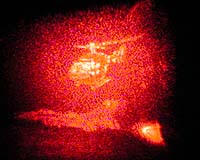
In a small research laboratory at UT Southwestern Medical Center, a grainy, red movie of circling fighter jets emerges from a table-top black box, while nearby, a video of a rotating human heart hangs suspended in a tank of gooey gel.

These images - the first true, three-dimensional, holographic movies - are the brainchild of Dr. Harold "Skip" Garner, professor of biochemistry and internal medicine at UT Southwestern.

While such movies will not be coming soon to a theater near you, they have earned Dr. Garner and his "holographic television" a spot on Popular Science magazine's list of the top five "great ideas for the future," featured in the June 2005 issue.

"I thought it was great that we made this list," Dr. Garner said. "It's good company to be in."

Also on the Popular Science list are a bionic eye, technology for a "smart" home, a tourist's spacesuit and the ultimate roller coaster.

"An important next step is to take our proof of principle technology that we have now and move it into a commercial entity," said Dr. Garner. "We think the two initial markets will be in medical visualization and military applications, such as heads-up displays for helmets and military aircraft and coordinating battlefield information."

In the long term, Dr. Garner said, entertainment uses could include 3-D multiplayer games, theme park or advertising displays, and "Holo TV."

He and his colleagues have worked with students in Southern Methodist University's Cox School of Business to develop a tentative business plan that explores the possible commercialization of the technology, focusing on medical applications.

"I predict that by the year 2020, that being the year of 'perfect vision,' we will have Holo TV in our homes," said Dr. Michael Huebschman, a postdoctoral researcher in Dr. Garner's lab and one of the developers of the technology.

Dr. Garner's holographic video system is based on complex optics principles, sophisticated computer programs, and a small computer chip covered with about a million tiny mirrors.


Community
Email This Article
Comment On This Article

Related Links
UT Southwestern Medical Center
SpaceDaily
Search SpaceDaily
Subscribe To SpaceDaily Express
Space Technology News - Applications and Research


Memory Foam Mattress Review
Newsletters :: SpaceDaily :: SpaceWar :: TerraDaily :: Energy Daily
XML Feeds :: Space News :: Earth News :: War News :: Solar Energy News


Industry Team Achieve New Communications Technology With AESA Radars
Baltimore MD (SPX) Jan 12, 2006
A team comprised of three leading US aerospace and defense contractors has demonstrated an innovative technological use of active electronically scanned array (AESA) radars for high-bandwidth communications.


  • 'Plastic Oil' Could Improve Fuel Economy In Cars, Chemists Say
  • Indian Gas Deal With Iran Should Also Spur Conservation Efforts: Think Tank
  • Estonia Opens 24-Million-Euro Wind Farm
  • Timor Sea Exploration Breakthrough

  • China To Build Four New Nuclear Reactors At Qinshan Plant
  • Climate: The Nuclear Option
  • US Nuclear Plants Vulnerable To Big Attack: Report
  • Japan Planning To Ship Radioactive Soil To US: Reports

  • Scientists Seek Sprite Light Source


  • East African Farming Genetically Transformed
  • NASA Uses Remotely Piloted Airplane To Monitor Grapes

  • Eco-Friendly Motor Rally Sets Off From Kyoto To Celebrate Environment

  • BAE Systems-Raytheon To Provide NextGen Mission Planning Capabilities For U-2
  • Boeing Projects $2.1 Trillion Market For New Commercial Airplanes
  • Pentagon Report Slams Boeing Aircraft Lease Deal
  • Tanker Scandal: Blame But No Punishment

  • NASA plans to send new robot to Jupiter
  • Los Alamos Hopes To Lead New Era Of Nuclear Space Tranportion With Jovian Mission
  • Boeing Selects Leader for Nuclear Space Systems Program
  • Boeing-Led Team to Study Nuclear-Powered Space Systems

  • The content herein, unless otherwise known to be public domain, are Copyright 1995-2006 - SpaceDaily.AFP and UPI Wire Stories are copyright Agence France-Presse and United Press International. ESA PortalReports are copyright European Space Agency. All NASA sourced material is public domain. Additionalcopyrights may apply in whole or part to other bona fide parties. Advertising does not imply endorsement,agreement or approval of any opinions, statements or information provided by SpaceDaily on any Web page published or hosted by SpaceDaily. Privacy Statement