|
 |
 |
 |
 |
 |
 |
 |
 |

 |
History's Greatest Comet Hunter Approaches Major Milestone
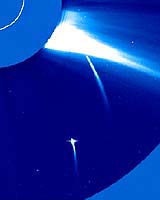
Paris (ESA) Jul 07, 2005 As of 6 July 2005, 989 comets have been discovered using the ESA/NASA Solar and Heliospheric Observatory (SOHO) spacecraft, which is expected to discover its 1000th comet this summer. The SOHO spacecraft, a joint effort between NASA and the European Space Agency, has been so prolific that it has accounted for almost half of all comet discoveries for which orbits have been computed in the history of astronomy. Before SOHO was launched, only 16 'sungrazing' comets had been discovered by space observatories. Based on that experience, who could have predicted that SOHO would discover more than sixty times that number, and in only nine years? Comets are chunks of ice and dust that zoom around the Solar System in elongated orbits. These 'dirty snowballs' are the nucleii of the comets. Comet nuclei are thought to be cosmic 'leftovers', the condensed remains of the gas and dust cloud that formed the Solar System. About 85 percent of the comets discovered so far by SOHO belong to the Kreutz group of 'sungrazing' comets, so named because their orbits take them very close to the Sun. The Kreutz sungrazers come within 800 000 km of the Sun's visible surface. In comparison, Mercury, the planet closest to the Sun, is about 57.6 million km from the solar surface. SOHO has also been used to discover three other well-populated comet groups: the Meyer (at least 55 members), Marsden (at least 21 members), and Kracht (24 members) groups. Comet groups are named after the astronomer who determined that they are related because they have similar orbits. Many SOHO comet discoveries have been by amateurs using SOHO images on the internet. SOHO comet hunters come from all over the world; the United States, United Kingdom, China, Japan, Taiwan, Russia, Ukraine, France, Germany and Lithuania are among the many countries whose citizens have used SOHO to chase comets. Almost all SOHO's comets are discovered using images from its Large Angle and Spectrometric Coronagraph (LASCO) instrument. LASCO is used to observe the faint, multimillion-degree outer atmosphere of the Sun, called the corona. A disk in the instrument is used to make an artificial eclipse, blocking direct light from the Sun so the much fainter corona can be seen. Sungrazing comets are discovered when they enter LASCO's field of view as they pass close by the Sun. SOHO successfully completed its primary mission in April 1998, and it has enough fuel to remain on station and keep hunting comets for decades, assuming the LASCO instrument continues to function. Community Email This Article Comment On This Article Related Links Enter SOHO 1000th comet contest SpaceDaily Search SpaceDaily Subscribe To SpaceDaily Express Asteroid and Comet Mission News, Science and Technology
 NASA'S Spitzer Finds Possible Comet Dust Around Dead Star
 Pasadena CA (SPX) Jan 12, 2006
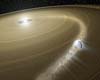
NASA's Spitzer Space Telescope has spotted what may be comet dust sprinkled around the white dwarf star G29-38, which died approximately 500 million years ago. |
|
|

| The content herein, unless otherwise known to be public domain, are Copyright 1995-2006 - SpaceDaily.AFP and UPI Wire Stories are copyright Agence France-Presse and United Press International. ESA PortalReports are copyright European Space Agency. All NASA sourced material is public domain. Additionalcopyrights may apply in whole or part to other bona fide parties. Advertising does not imply endorsement,agreement or approval of any opinions, statements or information provided by SpaceDaily on any Web page published or hosted by SpaceDaily. Privacy Statement |