|
 |
 |
 |
 |
 |
 |
 |
 |

 |
Historic Phoenix Mars Mission Flies Actel RTAX-S Devices
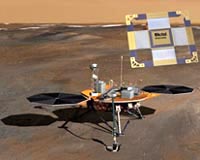
Mountain View CA (SPX) Aug 07, 2007 Bringing the benefits of low-power solutions to mission-essential instruments, Actel reports that its radiation-tolerant RTAX-S field-programmable gate arrays (FPGAs) are aboard NASA's Phoenix mission to Mars, which launched August 4 from Cape Canaveral Air Force Station in Florida. The Phoenix spacecraft includes a Meteorological Station (MET), provided by the Canadian Space Agency. MDA, a leading provider of robotic space systems, led construction of the MET instrument and has integrated Actel's one-million gate RTAX1000S-CQ352 device into the instrument subsystem, which is used to acquire, process and transmit temperature and pressure data to scientists and researchers back on Earth. "We have a stringent review and evaluation process for our suppliers," said Andrew Kerr, program manager for the MET program at MDA. "Following this review, we determined that the RTAX1000S-CQ352 provided the high reliability and stringent low-power metrics required for this mission-essential function. Using the high-density RTAX-S Actel device, MDA's MET instrument temperature and pressure subsystem is designed to provide accurate data throughout the mission, without failures."
Phoenix Mission Requires Low-power, High-reliability Instrumentation Once the Phoenix arrives on Mars, the MET instruments will be used constantly in surface operations, which are expected to last 150 days. These instruments are central to scientific exploration on Mars, providing the essential tools scientists need to learn more about the Martian climate and geology, as well as determine whether life has ever existed. The MET instrument will contribute to the success of the Phoenix mission. The MET instruments operate on a combination of battery power and solar energy. Because sunlight in the Martian polar region is even weaker than at its equator, all systems and their components must feature extremely efficient power management. "MDA needed a 'no risk,' low-power solution to develop their multi-million dollar system for space flight," said Rich Brossart, vice president of product marketing at Actel. "Actel's antifuse-based technology combines radiation tolerance with the industry's lowest power, enabling it to withstand the rigorous environments of space flight and exploration."
Actel's RTAX-S Family Ideal for Mission-Critical Space Applications The family, which includes the RTAX1000S used in the Phoenix mission's flight, offers unique features desirable for space-flight applications, including single-event upset (SEU)-hardened flip-flops, usable error-corrected on-board memory and a large number of user I/O. These, in combination with the inherent benefits of Actel's nonvolatile products, give designers the ability to minimize power consumption, reduce component count and save board space and weight while meeting their density, performance and radiation-resistance requirements. Actel is a leading provider of FPGAs for high-reliability space applications. Over the last decade, Actel FPGAs have been onboard more than 100 launches and flown on over 300 satellites and spacecraft, including GPS, Mars Reconnaissance Orbiter, Mars Explorer Rovers 1 and 2 (Spirit and Opportunity), Echostar and Globalstar. Community Email This Article Comment On This Article Related Links Actel Space Tourism, Space Transport and Space Exploration News
 Spaceport America Design Team Selected
 Las Cruces NM (SPX) Aug 03, 2007
A team of U.S. and British architects and designers has been recommended for award to design the primary terminal and hangar facility at Spaceport America, announced Kelly O'Donnell, Chair of the New Mexico Spaceport Authority (NMSA). URS Corporation, one of the world's largest design and engineering firms, teamed with lead designer Foster and Partners of the United Kingdom to submit the winning design. The selection was the result of an international competition for the chance to design the facility that will symbolize the world's first purpose-built commercial spaceport. |
|
|

| The content herein, unless otherwise known to be public domain, are Copyright 1995-2007 - SpaceDaily.AFP and UPI Wire Stories are copyright Agence France-Presse and United Press International. ESA Portal Reports are copyright European Space Agency. All NASA sourced material is public domain. Additional copyrights may apply in whole or part to other bona fide parties. Advertising does not imply endorsement,agreement or approval of any opinions, statements or information provided by SpaceDaily on any Web page published or hosted by SpaceDaily. Privacy Statement |