|
 |
 |
 |
 |
 |
 |
 |
 |

 |
Hiroshima Devastation Heralded Three Weeks Earlier In US Desert
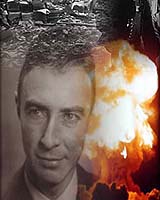
Trinity Site, New Mexico (AFP) Jul 10, 2005 "Now, I am become Death, the destroyer of worlds," said the father of the atom bomb as he witnessed the world's first nuclear explosion three weeks before Hiroshima was flattened. Physicist Robert Oppenheimer solemnly cited the Hindu holy text, the Bhagavad-Gita, as he watched a blinding flash give way to a huge mushroom cloud over the remote desert of the southwestern US state of New Mexico. One of his colleagues witnessing the first nuclear test shortly before dawn on July 16, 1945, summed up the bomb's awesome power of the bomb more prosaically: "Now we are all sons of bitches," said fellow physicist Kenneth Bainbridge. "We knew the world would not be the same. A few people laughed, a few people cried, most people were silent," Oppenheimer said years later of the reactions of the scientists, who were relieved the crucial test was successful, but horrified at the deadly power they had harnessed. Work on the Manhattan Project, the code name for the development of the nuclear bomb, had begun in 1943 under an impenetrable blanket of secrecy, with the spectre of a failure never far from the surface. Three atomic bombs were ready by the end of June 1945 as the United States planned what promised to be a very tough and bloody invasion of imperial Japan. Two of the bombs, nicknamed "Little Boy" - a uranium device - and "Fat Man," a plutonium bomb, were readied for shipment to the Pacific in the hope of ending World War II and avoiding a US massacre on Japanese beachheads. But while the scientific team was confident the uranium bomb would work, the plutonium device had to be tested as quietly as possible before it was dropped on Japan. By the spring of 1944, Oppenheimer and Bainbridge had picked an isolated spot in a stretch of desert prophetically named "Journey of Death" that lay 300 kilometers (200 miles) south from their development base at Los Alamos, in northern New Mexico. The most powerful weapon in history, dubbed the "gadget" by its designers, was hoisted onto a 100-foot (30 meter) steel tower at the new Trinity Site after US president Harry Truman gave the go-ahead. All that was left was for scientists to electronically trigger the detonation of the bomb, identical to the one that would be dropped on Nagasaki, from their bunker 10 kilometers (six miles) away. A few seconds before 5:30 am on July 16, the countdown ended and a massive conventional explosion took place, sparking a nuclear reaction in the weapon's plutonium core and turning the night sky to day. "The "whole country was lighted by a searing light with the intensity many times that of the midday sun," wrote General Thomas Farrell, a top military man at the test site. "It lighted every peak, crevasse and ridge of the nearby mountain range with a clarity and beauty that cannot be described but must be seen to be imagined." The blast was followed by a rush of wind and then by a "strong, sustained awesome roar that warned of doomsday and made us feel we puny things were blasphemous to dare tamper with the forces heretofore reserved for the Almighty," Farrell wrote. The blast shattered windows up to 200 kilometers (120 miles) away, but residents of the region were told that a munitions dump on the weapons range had exploded. Edward Teller, one of the lead scientists of the project, put on sunglasses under welder's goggles to watch the blast without being blinded. At the core of the weapon, temperatures reached millions of degrees, rivalling those at the core of the sun. After sunrise, a team armed with gear to protect them from radiation made their way to the blast site from which a huge circle of scorched earth had radiated. The tower had completely vanished, apart from two steel footings set in concrete, and a shallow 800-meter (yard) crater that was coated in green glass had appeared where the heat had melted the desert sand. Just four hours after the test, the Navy cruiser "USS Indianapolis" set sail from San Francisco towards the Pacific island of Tinian with a secret cargo on board: "Little Boy," who would wreak death and destruction on the Japanese city of Hiroshima on August 6. Community Email This Article Comment On This Article Related Links SpaceDaily Search SpaceDaily Subscribe To SpaceDaily Express Learn about nuclear weapons doctrine and defense at SpaceWar.com Learn about missile defense at SpaceWar.com All about missiles at SpaceWar.com Learn about the Superpowers of the 21st Century at SpaceWar.com
 World Powers Threaten Defiant Iran Over Nuclear Crisis
 Vienna (AFP) Jan 11, 2006
World powers threatened Iran with UN Security Council sanctions Wednesday after it resumed sensitive nuclear activities as a defiant Tehran vowed to press ahead with its disputed atomic programme. |
|
|

| The content herein, unless otherwise known to be public domain, are Copyright 1995-2006 - SpaceDaily.AFP and UPI Wire Stories are copyright Agence France-Presse and United Press International. ESA PortalReports are copyright European Space Agency. All NASA sourced material is public domain. Additionalcopyrights may apply in whole or part to other bona fide parties. Advertising does not imply endorsement,agreement or approval of any opinions, statements or information provided by SpaceDaily on any Web page published or hosted by SpaceDaily. Privacy Statement |