|
 |
 |
 |
 |
 |
 |
 |
 |

 |
Hinode's Solar Data Ready For Europe's Access
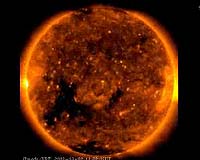
Oslo, Norway (SPX) Jun 07, 2007 Europe's scientists have free access to spectacular data and images from Hinode, a Japan-led mission with ESA participation that studies the mechanisms that power the Sun's atmosphere and cause violent eruptions. This free access is now possible thanks to the opening of the Hinode Science Data Centre in Norway, developed and run by the Institute of Theoretical Astrophysics at the University of Oslo on behalf of ESA and the Norwegian Space Centre. It is part of ESA and Norway's joint contribution to this solar mission. The other part of the joint contribution to Hinode consists of ground station coverage through the SvalSat downlink station at Svalbard, which nearly quadruples the data rate and thus significantly increases Hinode's science return. Svalsat is the only station in the world that can receive Hinode's data during each of its 15 daily orbits. "Our European solar science community is extremely strong. We have several space missions with ESA leadership, or strong European participation, which are producing outstanding results about the Sun and its interaction with the planetary environment," says Bernhard Fleck, ESA's SOHO and Hinode Project Scientist. "When ESA, in a joint venture with Norway, decided to contribute to Hinode, it was to broaden the possibilities for European scientists to participate in this exciting new mission and at the same time increase the science possibilities for the worldwide scientific community," he continues. In exchange for ESA's and Norway's contribution to the mission, European scientists have been guaranteed free access to the Hinode data by the Japan Aerospace Exploration Agency (JAXA). "No doubt European scientists will make great use of this data and will produce excellent new science about our daylight star," concludes Fleck. The quality of data now available through the Hinode Science Data Centre can be appreciated in spectacular movies of the Sun, obtained by the XRT X-ray telescope on board, made public on 27 May by the National Astronomical Observatory of Japan (NAOJ). The first X-ray movie was obtained between January and April 2007. It shows the medium-term evolution of the dynamic solar corona. The corona is a portion of the solar atmosphere that extends for millions of kilometres into space and is much hotter than the solar surface - a puzzle still not completely understood by scientists. The second movie, obtained on 16 March 2007, provides a close-up view of X-ray-bright points in what is believed to be a quiet region of the Sun's surface. The high resolution of the XRT instrument helped scientists see that these X-ray-bright points - widely distributed - are actually 'loop' structures demonstrating intense activity. "Data like this, being gathered by Hinode since it started operating in October 2006, is a treasure chest for our scientists," says Stein Vidar Hagfors Haugan, Executive Director of the data centre. "With the archiving system developed in our data centre, innovative in terms of contextual searching capability and speed, we believe we are providing a great contribution to maximising the scientific return of this new exciting mission." Email This Article
Related Links  Greenbelt MD (SPX) May 30, 2007
Sound waves escaping the Sun's interior create fountains of hot gas that shape and power the chromosphere, a thin region of the sun's atmosphere which appears as a ruby red "ring of fire" around the moon during a total solar eclipse, according to research funded by NASA and the National Science Foundation (NSF). These results were presented May 29, at the American Astronomical Society Meeting in Honolulu, Hawaii. |
|
|

| The content herein, unless otherwise known to be public domain, are Copyright 1995-2006 - SpaceDaily.AFP and UPI Wire Stories are copyright Agence France-Presse and United Press International. ESA PortalReports are copyright European Space Agency. All NASA sourced material is public domain. Additionalcopyrights may apply in whole or part to other bona fide parties. Advertising does not imply endorsement,agreement or approval of any opinions, statements or information provided by SpaceDaily on any Web page published or hosted by SpaceDaily. Privacy Statement |