|
 |
 |
 |
 |
 |
 |
 |
 |

 |
High Tech Weapons Could Minimize Casualties In Urban War
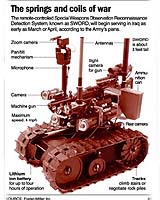
Singapore (AFP) Feb 21, 2006 High-tech weapons could minimize casualties in urban warfare, a form of battle that has increasingly become unavoidable in the age of terrorism, defence experts say. Fears of high casualty rates from old-fashioned bloody hand-to-hand combat have made military commanders dread urban combat. But high-tech weaponry including precision guided bombs, unmanned vehicles and powerful armoured tanks have reduced troops' exposure to life-threatening situations, military experts said at an Asian security conference Monday. They said computer-assisted fighting is set to play an even greater role and could further reduce the casualty rate in the new theater of war. A private French company, Sagem Defence Securite, said it was in the process of developing an integrated electronic soldier system that would make an infantryman a virtual computerised fighting machine. Sagem has been awarded a contract by the French government to develop about 32,000 of these soldier systems for delivery between 2007 and 2012, said the company's business development director Patrick Curlier. The US is also planning to send robot soldiers -- called the Special Weapons Observation Reconnaissance Detection Systems (SWORDS) into the field in Iraq, said John Parmentola, director for research and laboratory management for the US Army. The robots are fully armed, and when the human operator verifies that a suitable target is within sight, it fires from its powerful guns. Singapore has designated one battalion for urban warfare experimentation and is developing an Advanced Combat Man System, said the city-state's army chief, Major General Desmond Kuek. "This urban-capable battalion will be equipped with an integrated network of sensors with mini-UAVs and robotics to enhance intelligence collection and situation awareness," Kuek said, referring to Unmanned Aerial Vehicles. As cities become more populated and extremist networks seek refuge in urban centers, conventional armed forces worldwide need to evolve their doctrines and weapons to better fight a new kind of enemy, the experts said. "The urban fight was one that many years ago was considered a place that you did not want to fight," said Lieutenant General Thomas Metz, the former senior ground tactical commander of US-led coalition forces in Iraq from January 2004 to February 2005. While the advice of the ancient Chinese military strategist Sun Tzu against attacking cities was true in his time, it has become unavoidable in modern warfare, Metz said. "We will fight in urban terrain and we've got to learn how to do that, and we have to in Iraq," said Metz, who is currently the commanding officer of the US Army's III Corps at Fort Hood. Brigadier Justin Kelly, commander of the land warfare development centre of the Australian Defence Force, said his country was adapting its military doctrine to cover urban warfare situations. "Our view is the future war is urban," Kelly said. "Militarily, urban warfare will be a wicked problem." Armed forces worldwide are generally trained for combat against a conventional enemy, with manoeuvres involving large formations of troops. Urban warfare, however, necessitates a new set of doctrines that involve mobilising specialised forces, new tactics and a complex mix of psychological warfare and information operations. During the US siege of Sadr City in Iraq in 2004, the US brigade commander in charge noticed that a lot of the firing came from an area where there was no electric power, sewage was clogged, trash was uncollected and there was no clean water supply, Metz said. As they gradually captured parts of the city, the commander restored power, cleaned the drainage, had the garbage collected and gave residents clean water. "So (the) urban fight is far beyond the kinetic fight," he said.
Source: Agence France-Presse Community Email This Article Comment On This Article Related Links - The latest in Military Technology for the 21st century at SpaceWar.com
 Spectrum Platform Selected For Laser RADAR App For US DoD
 Columbia MD (SPX) Feb 21, 2006
Spectrum Signal Processing has announced the selection of the flexComm SDR-4000 software defined radio platform by Digital Signal Corporation (DSC) for the development of a laser RADAR for the U.S. Department of Defense. The laser RADAR based system is being designed to perform precise 3-D facial recognition in a fraction of a second from distances in excess of 10 meters. |
|
|

| The content herein, unless otherwise known to be public domain, are Copyright 1995-2006 - SpaceDaily.AFP and UPI Wire Stories are copyright Agence France-Presse and United Press International. ESA PortalReports are copyright European Space Agency. All NASA sourced material is public domain. Additionalcopyrights may apply in whole or part to other bona fide parties. Advertising does not imply endorsement,agreement or approval of any opinions, statements or information provided by SpaceDaily on any Web page published or hosted by SpaceDaily. Privacy Statement |