|
 |
 |
 |
 |
 |
 |
 |
 |

 |
High Risk Of Major Tsunami In Northern Caribbean
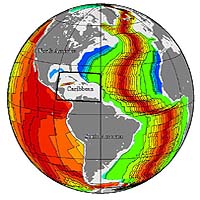
Washington DC (SPX) Mar 17, 2005 The potential for devastating tsunamis in the northern Caribbean is high, say marine scientists, based on their analysis of historical data since the arrival of Columbus. Several natural phenomena could trigger giant tsunamis, they say, with effects felt in the islands of the Greater and Lesser Antilles and along the east and Gulf coasts of the United States. Nancy Grindlay and Meghan Hearne of the University of North Carolina Wilmington and Paul Mann of the University of Texas at Austin focus on one major source of past tsunamis in the region: movement along the boundary between the North American and Caribbean tectonic plates. Writing in the March 22 issue of Eos, the newspaper of the American Geophysical Union, they say that at least 10 significant tsunamis have been documented in the northern Caribbean since 1492, six of which are known to have resulted in loss of life. All 10 were triggered by movement along this plate boundary, which lies along the north coast of Hispaniola (Haiti and the Dominican Republic) and extends some 3,200 kilometers (2,000 miles) from Central America to the Lesser Antilles. Previous tsunamis destroyed Port Royal, Jamaica, in 1692, killed at least 10 Jamaicans on the island's south coast in 1780, and ravaged the north coast of Hispaniola and the Virgin Islands in 1842. The most recent of the destructive northern Caribbean tsunami occurred in 1946 and was triggered by a magnitude 8.1 earthquake in the Dominican Republic. It killed around 1,800 people. The researchers estimate that with increased populations, especially in coastal areas, some 35.5 million people are now at risk should another strong tsunami hit the northern Caribbean. They note that in addition to their own studies of fault lines along the North American and Caribbean plate boundary, other researchers have studied the risk to the northern Caribbean from submarine landslides, both in the region and as far away as the Canary Islands. In the pre-1492 period, tsunamis greater than any in the past 500 years may have occurred, the scientists say, based on their study of underwater landslides off the north coast of Puerto Rico. Grindlay and her colleagues are planning to visit the region later this month to investigate possible linkages between groundwater flow from Puerto Rico and underwater seeps in areas where land has subsided. Such flows, or fluxes, could contribute to small landslides that might trigger tsunamis. In the future, they hope to drill into the ocean bed to determine when and how often land had collapsed in the prehistoric era. "The recent devastating tsunami in the Indian Ocean has raised public awareness of tsunami hazard and the need for early warning systems in high-risk areas such as the Caribbean," Grindlay said in a statement. "An Intra-Americas Sea Tsunami Warning Project proposal has been approved by the Intergovernmental Oceanographic Commission, and meetings to plan implementation are scheduled for this spring and summer." Community Email This Article Comment On This Article Related Links American Geophysical Union SpaceDaily Search SpaceDaily Subscribe To SpaceDaily Express Tectonic Science and News
 Ash Continuing To Spew From Vanuatu Volcano
 Sydney (AFP) Dec 12, 2005
Thousands of tonnes of ash are continuing to spew from a volcano in Vanuatu, but officials said Monday the activity on the South Pacific nation was not likely to result in a major deadly eruption. |
|
|

| The content herein, unless otherwise known to be public domain, are Copyright 1995-2006 - SpaceDaily.AFP and UPI Wire Stories are copyright Agence France-Presse and United Press International. ESA PortalReports are copyright European Space Agency. All NASA sourced material is public domain. Additionalcopyrights may apply in whole or part to other bona fide parties. Advertising does not imply endorsement,agreement or approval of any opinions, statements or information provided by SpaceDaily on any Web page published or hosted by SpaceDaily. Privacy Statement |