|
 |
 |
 |
 |
 |
 |
 |
 |

 |
High-Tech Robot Skin
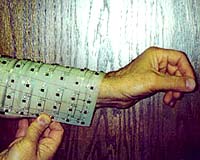
Greenbelt MD (SPX) Jun 09, 2005 A ballerina gracefully dances on a small stage. She is followed not by a male partner, but by a robotic arm manipulator that seems to sense her every move. For NASA Goddard technologist Vladimir Lumelsky, the performance shows the future of robotics. It also demonstrates an advanced technology that Lumelsky hopes to develop as part of the push from NASA's Goddard Space Flight Center to develop niche robotics capabilities critical for carrying out the Vision for Space Exploration. Lumelsky, until recently a professor at the University of Wisconsin-Madison, has begun setting up a laboratory at Goddard to develop a high-tech covering that would enable robots to sense their environment and react to it, much like humans respond when something or someone touches their skin. Such a technology, which he refers to as a "High-Tech Skin," is essential for carrying out the Vision for Space Exploration because the Vision depends heavily on humans and robots working together under a variety of working conditions, many of them highly unstructured, Lumelsky said. "Robots move well on their own, especially when nothing is in the way," Lumelsky explained. However, change the environment and a different picture emerges. "Robots should be able to react, but today's robots can't," he said. "That's the difference and that's got to change for exploration."
Touch Sensing Remains Key Although great headway is being made in the area of computer vision, vision isn�t enough, he said. "Humans can survive without sight, but they can�t survive without tactile sensing. The skin is the biggest organ in our body. It's nothing more than a huge sensor."
Use of Infrared Sensors The idea is to develop a "sensitive skin" that technicians could use to cover a robot. This skin will include more than 1,000 infrared sensors that would detect an object, and send the information to the robot's "brain." The brain would digest the information, apply reasoning and react within milliseconds by directing the robot to move. Future skin prototypes likely will have a higher density of sensors on the skin, which will provide the robots with even greater dexterity. The flexible plastic modules that will house the skin�s electronics will have to undergo a lot of testing to assure that they�re space qualified and able to withstand radiation and extreme changes in light and temperature, such as those that occur on other planets. In addition, embedding the electronics on a large surface material, or printing the skin like wallpaper, presents another major hurdle. Work also is needed in the area of motion-planning development and intelligence, he added. Since moving to Goddard, Lumelsky began identifying resources needed to create his laboratory. The sensitive skin was identified as a key technology to develop at Goddard. It would prove vital in situations where humans and robots work side-by-side in the construction of large telescopes and in the operation of both in-space and extraterrestrial equipment. Community Email This Article Comment On This Article Related Links SpaceDaily Search SpaceDaily Subscribe To SpaceDaily Express All about the robots on Earth and beyond!
 Engineers Deliver Robot to Neutralize Remote Explosives
 Tyndall AFB (SPX) Jun 30, 2005
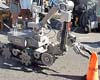
Engineers from the Air Force Research Laboratory Materials and Manufacturing Directorate have rapidly prototyped, developed, and delivered low-cost expendable robots to disable and dispose of improvised explosive devices. |
|
|

| The content herein, unless otherwise known to be public domain, are Copyright 1995-2006 - SpaceDaily.AFP and UPI Wire Stories are copyright Agence France-Presse and United Press International. ESA PortalReports are copyright European Space Agency. All NASA sourced material is public domain. Additionalcopyrights may apply in whole or part to other bona fide parties. Advertising does not imply endorsement,agreement or approval of any opinions, statements or information provided by SpaceDaily on any Web page published or hosted by SpaceDaily. Privacy Statement |