|
 |
 |
 |
 |
 |
 |
 |
 |

 |
High-Intensity Ultrasound Creates Hollow Nanospheres And Nanocrystals
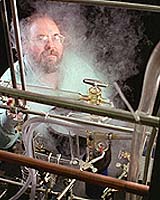
Champaign IL (SPX) Feb 23, 2005 Using high-intensity ultrasound, researchers at the University of Illinois at Urbana-Champaign have created hollow nanospheres and the first hollow nanocrystals. The nanospheres could be used in microelectronics, drug delivery and as catalysts for making environmentally friendly fuels. "We use high-intensity ultrasound to generate nanoparticles of molybdenum disulfide or molybdenum oxide, which bind to the surface of tiny silica spheres that are much smaller than red blood cells," said Ken Suslick, the Marvin T. Schmidt Professor of Chemistry at Illinois and a researcher at the Beckman Institute for Advanced Science and Technology. "After heating the spheres to produce uniform coatings, we use hydrofluoric acid to etch away the silica, leaving hollow shells of the desired material." Suslick and former postdoctoral research associate Arul Dhas describe their work in a paper that has been accepted for publication in the Journal of the American Chemical Society, and posted on its Web site. Funding was provided by the National Science Foundation. Hollow nanospheres crafted from molybdenum disulfide could serve as a superior catalyst for removing sulfur-containing compounds from gasoline and other fossil fuels. "Molybdenum-disulfide is a layered material, but its catalytic activity occurs at its edges," Suslick said. "By distorting and breaking up the layers, hollow nanospheres offer increased edge-surface area, as well as access to both inner and outer shell surfaces." Further processing of hollow spheres made of molybdenum oxide, however, results in the unusual formation of hollow crystals that resemble truncated cubes. Upon heating a second time � referred to as thermal annealing � the hollow molybdenum oxide spheres are transformed into single-crystal boxes with spherical hollow voids. The sonochemical procedure could be easily applied to other material systems to create additional types of hollow, nanostructured particles, Suslick said. Sonochemistry arises from acoustic cavitation � the formation, growth and implosion of small gas bubbles in a liquid blasted with sound. The collapse of these bubbles generates intense local heating, forming a hot spot in the cold liquid with a transient temperature of about 9,000 degrees Fahrenheit, the pressure of about 1,000 atmospheres and the duration of about 1 billionth of a second. For a rough comparison, these values correspond to the temperature of the surface of the sun, the pressure at the bottom of the ocean, and the lifetime of a lightning strike. Ultrasound consists of sound waves above 18,000 cycles per second, too high-pitched to be audible to human ears. Community Email This Article Comment On This Article Related Links University of Illinois at Urbana-Champaign SpaceDaily Search SpaceDaily Subscribe To SpaceDaily Express Nano Technology News From SpaceMart.com Computer Chip Architecture, Technology and Manufacture
 Prof Develops Cancer Nanobomb
 Newark DE (SPX) Oct 14, 2005
University of Delaware researchers are opening a new front in the war on cancer, bringing to bear new nanotechnologies for cancer detection and treatment and introducing a unique nanobomb that can literally blow up breast cancer tumors. |
|
|

| The content herein, unless otherwise known to be public domain, are Copyright 1995-2006 - SpaceDaily.AFP and UPI Wire Stories are copyright Agence France-Presse and United Press International. ESA PortalReports are copyright European Space Agency. All NASA sourced material is public domain. Additionalcopyrights may apply in whole or part to other bona fide parties. Advertising does not imply endorsement,agreement or approval of any opinions, statements or information provided by SpaceDaily on any Web page published or hosted by SpaceDaily. Privacy Statement |