|
 |
 |
 |
 |
 |
 |
 |
 |

 |
High-Energy Laser Destroys Large-Caliber Rocket
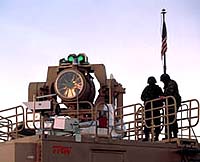
Redondo Beach - May 11, 2004 As the scope of battlefield threats continues to expand, so does the versatility of a high-energy laser system to defeat them. The U.S. Army's Mobile Tactical High Energy Laser (MTHEL) testbed destroyed a rocket on May 4 that's larger, faster and that flies higher than previous threats destroyed by the laser weapon demonstrator. Northrop Grumman Corporation built the demonstrator for the Army and the Israel Ministry of Defence (IMoD). Tuesday's successful intercept and destruction of the large-caliber rocket carrying a live warhead took place at 12:45 p.m. MDT during a live-fire test of the MTHEL testbed at the Army's White Sands Missile Range, N.M. The large-caliber rocket is capable of twice the range, achieves more than three times the altitude, and carries a much larger warhead than previous targets. Many countries already possess large-caliber rockets. The destroyed rocket is representative of threats faced by U.S. and Israeli forces. "The destruction of a new threat type once again demonstrates the capability of the MTHEL testbed," said Wes Bush, president of Northrop Grumman's Space Technology sector. "We are excited about the historic accomplishments and we are fully prepared to move to the next stage of building the MTHEL prototype." The rocket shot down is faster and has more mass than Katyusha rockets the MTHEL testbed has destroyed since testing began in 2000. A more compact, mobile and easily transportable THEL, the MTHEL prototype will give the Army its first deployable laser weapon system. Northrop Grumman began work on the existing testbed in 1996 when it was called the THEL/Advanced Concept Technology Demonstrator (ACTD). MTHEL will be the first tactical and mobile, directed-energy weapon capable of shooting down rockets and other tactical targets in flight to protect deployed forces and civilians of the U.S. and its friends and allies. The existing MTHEL testbed was designed, developed and produced by a Northrop Grumman-led team of U.S. and Israeli contractors for the US Space & Missile Defense Command, Huntsville, Ala., and for ImoD. In addition to Northrop Grumman's Space Technology and Mission Systems sectors, US companies involved in testbed development are Ball Aerospace, Boulder, Colo., and Brashear LP, Pittsburgh, Pa. Israeli companies that supported THEL ACTD development are Electro-Optic Industries, Ltd., Rehovat; Israel Aircraft Industries, Ltd., Yehud Industrial Zone; RAFAEL, Haifa; and Tadiran, Holon. In testing to date, the MTHEL testbed has destroyed 28 Katyusha rockets and five artillery shells in flight. Community Email This Article Comment On This Article Related Links MTHEL program at Northrop Grumman SpaceDaily Search SpaceDaily Subscribe To SpaceDaily Express Space Technology News - Applications and Research
 LIGO Up And Running, But Gravity Waves Remain Elusive
 Washington DC (SPX) Jan 10, 2006
Scientists working on the Laser Interferometer Gravitational-Wave Observatory said Monday the facility has reached its target detection sensitivity, but the goal of finding the elusive phenomena known as gravity waves remains as elusive as ever. |
|
|

| The content herein, unless otherwise known to be public domain, are Copyright 1995-2006 - SpaceDaily.AFP and UPI Wire Stories are copyright Agence France-Presse and United Press International. ESA PortalReports are copyright European Space Agency. All NASA sourced material is public domain. Additionalcopyrights may apply in whole or part to other bona fide parties. Advertising does not imply endorsement,agreement or approval of any opinions, statements or information provided by SpaceDaily on any Web page published or hosted by SpaceDaily. Privacy Statement |