|
 |
 |
 |
 |
 |
 |
 |
 |

 |
Here Comes the Sun
Pasadena - Apr 02, 2004 Little did the Beatles know that their metaphor "Here comes the sun" would be taken literally one day. To the team behind NASA's Genesis mission, it has been years since they sent their "little darling," a small spacecraft with a wingspan of 22 feet (6.8 meters), out to collect and bring back a piece of the Sun.
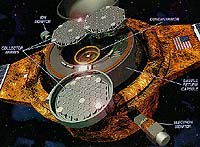
"After more than two years of collecting solar wind ions, we're thrilled that the Genesis spacecraft is about to close up and come home," said Donald Sweetnam, Genesis project manager at NASA's Jet Propulsion Laboratory, Pasadena, Calif. On Thursday, April 1, NASA turned off the solar wind concentrator, stowed the collector arrays, closed the science canister cover, and lock it tight. And on Friday NASA will close the sample return capsule backshell and latch it in the configuration necessary for entry through Earth's atmosphere five months later on September 8. Genesis is NASA's first sample return mission since the last Apollo mission in 1972, and the first ever to return material collected beyond the Moon. The science collection began November 30, 2001, with the opening of the spacecraft's science canister and the extension of special collector arrays to catch atoms from the solar wind. The atoms it has collected, believed to have preserved the composition of the solar nebula "cloud" from which our solar system developed, will help scientists better understand conditions in the distant past before Earth and other planets formed. "Genesis will return a small but precious amount of samples leading to data that is crucial to our knowledge of the Sun and the formation of our solar system," said Genesis principal investigator Dr. Donald Burnett of the California Institute of Technology in Pasadena. To help carry out its mission, Genesis has four dynamic instruments on board: bicycle-tire-sized solar-wind collector arrays, made of pure materials such as diamond, gold, silicon and sapphire, designed to entrap solar wind particles; an ion monitor to record the speed, density, temperature and approximate composition of the solar wind ions; an electron monitor to make similar measurements of electrons in the solar wind; and an ion concentrator to separate and focus elements of the solar wind like oxygen and nitrogen into special collectors. "The science canister on the spacecraft contains the precious solar wind particles in their original state, protected from breakage and contamination with terrestrial matter during launch and recovery," Burnett said. On May 2, 2004, the spacecraft will fly past Earth, positioning itself for daylight recovery. Four months later, the sample-return capsule will make a dramatic Earth entrance by parachuting toward the ground at the Utah Testing and Training Range of the U.S. Air Force. Specially trained helicopter pilots will catch the capsule in midair to prevent the delicate samples from being disturbed by the impact of a landing. The samples will then be preserved in a special laboratory at NASA's Johnson Space Center in Houston, and allocated for scientific study over the next century. "Like all sample return missions, Genesis science really begins when the spacecraft phase of the mission ends," Burnett said. "It's been a long coming, but we can't wait to get to the analysis phase." Then, everything will be all right. Community Email This Article Comment On This Article Related Links Genesis Mission SpaceDaily Search SpaceDaily Subscribe To SpaceDaily Express Nuclear Space Technology at Space-Travel.com
 Carina Nebula Dust Pillars Harbor Embedded Stars
 Boulder CO (SPX) May 31, 2005
Astronomers using NASA's Spitzer Space Telescope have imaged a giant molecular cloud being shredded by howling stellar winds and searing radiation, exposing a group of towering dust pillars harboring infant stars, according to a University of Colorado at Boulder researcher. |
|
|

| The content herein, unless otherwise known to be public domain, are Copyright 1995-2006 - SpaceDaily.AFP and UPI Wire Stories are copyright Agence France-Presse and United Press International. ESA PortalReports are copyright European Space Agency. All NASA sourced material is public domain. Additionalcopyrights may apply in whole or part to other bona fide parties. Advertising does not imply endorsement,agreement or approval of any opinions, statements or information provided by SpaceDaily on any Web page published or hosted by SpaceDaily. Privacy Statement |