|
 |
 |
 |
 |
 |
 |
 |
 |

 |
Helios II, A New Generation Of Military Satellites
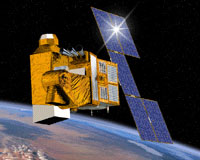
Toulouse, France (SPX) Oct 18, 2004 CNES is gearing up for a special launch in December. Ariane 5 will be lofting 6 satellites into orbit at once - a first for Europe's launcher. Among the passengers will be the Helios IIA satellite, designed to give the Helios military surveillance system enhanced resolution and data access capability. Helios IIA satellite is scheduled to join its 2 predecessors, Helios IA and IB, in orbit. Helios II, which also comprises 2 satellites, is a second-generation military surveillance programme developed by France in partnership with Spain and Belgium. Helios II will operate in the visible and infrared portions of the spectrum to deliver imagery to the French military day and night. France has also an agreement to exchange some of Helios II's optical data for future radar data now under development in Germany and Italy, thus affording it an all-weather imaging capability. Enhancements provided by Helios II include significantly improved resolution, more imaging capacity and faster access to imagery. The new system, which will also support targeting, guidance, mission planning and battle damage assessment, has been designed to accommodate future upgrades, including new users and new sensors. Helios IIA will be launched along with the Essaim demonstrator comprising 4 microsatellites developed by the French defense procurement agency (DGA). The aim of this demonstrator is to lay the groundwork for a future space-based electronic intelligence (ELINT) programme. Finally, the last passenger on board Ariane flight 165 will be CNES's Parasol microsatellite, dedicated to observing clouds and aerosols. Community Email This Article Comment On This Article Related Links CNES SpaceDaily Search SpaceDaily Subscribe To SpaceDaily Express Military Space News at SpaceWar.com
 Space Group To Activate New Unit
 Colorado Springs CO (SPX) Jan 6, 2006
Air Force Reserve Command's 310th Space Group will travel deeper into the space program when it activates a new unit Jan. 7. Headquarters Reserve National Security Space Institute will be a Reserve associate unit to the National Security Space Institute in Colorado Springs, Colo. The institute is the Department of Defense's focal point for providing education about space power in joint warfighting. |
|
|

| The content herein, unless otherwise known to be public domain, are Copyright 1995-2006 - SpaceDaily.AFP and UPI Wire Stories are copyright Agence France-Presse and United Press International. ESA PortalReports are copyright European Space Agency. All NASA sourced material is public domain. Additionalcopyrights may apply in whole or part to other bona fide parties. Advertising does not imply endorsement,agreement or approval of any opinions, statements or information provided by SpaceDaily on any Web page published or hosted by SpaceDaily. Privacy Statement |