|
 |
 |
 |
 |
 |
 |
 |
 |

 |
Heavier Hydrogen On The Atomic Scale Reduces Friction
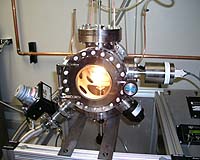
Argonne IL (SPX) Nov 06, 2007 Scientists may be one step closer to understanding the atomic forces that cause friction, thanks to a recently published study by researchers from the University of Pennsylvania, the University of Houston and the U.S. Department of Energy's Argonne National Laboratory. The research, led by Robert Carpick of the University of Pennsylvania, found a significant difference in friction exhibited by diamond surfaces that had been coated with different isotopes of hydrogen and then rubbed against a small carbon-coated tip. Scientists lack a comprehensive model of friction on the nanoscale and only generally grasp its atomic-level causes, which range from local chemical reactions to electronic interactions to phononic, or vibrational, resonances. To investigate the latter, Argonne scientist Anirudha Sumant and his colleagues used single-crystal diamond surfaces coated with layers of either atomic hydrogen or deuterium, a hydrogen atom with an extra neutron. The deuterium-terminated diamonds had lower friction forces because of their lower vibrational frequencies, an observation that Sumant attributed to that isotope's larger mass. They have also observed same trend on a silicon substrate, which is structurally similar to that of diamond. Previous attempts to make hydrogen-terminated diamond surfaces relied on the use of plasmas, which tended to etch the material. "When you're looking at such a small isotopic effect, an objectively tiny change in the mass, you have to be absolutely sure that there are no other complicating effects caused by chemical or electronic interferences or by small topographic variations," Sumant said. "The nanoscale roughening of the diamond surface from the ion bombardment during the hydrogen or deuterium termination process, even though it was at very low level, remained one of our principal concerns." Sumant and his collaborators had looked at a number of other ways to try to avoid etching, even going to such lengths as to soak the films in olive oil before applying the hydrogen layers. However, no method had provided a smooth, defect-free hydrogen layer with good coverage that would avoid generating background noise, he said. However, while performing work at the University of Wisconsin-Madison, Sumant developed a system for depositing diamond thin films. The technique, called hot filament chemical vapor deposition, involves the heating of a tungsten filament (like those found in incandescent light bulbs) to over 2000 degrees Celsius. If the diamond film is exposed to a flow of molecular hydrogen while sitting within a centimeter of the hot filament, the heat will cause the molecular hydrogen to break down into atomic hydrogen, which will react with the film's surface to create a perfectly smooth layer. Since this method does not require the use of plasma, there is no danger of ion-induced etching. "We've proved that this is a gentler method of terminating a diamond surface," Sumant said. Sumant said that he hopes to use the knowledge gained from the experiment to eventually discover a way to manipulate the friction of surfaces on the atomic level. Such a result would prove immensely valuable to the development of nanoelectromechanical systems, or NEMS, based on diamonds, one of Sumant's primary research interests at Argonne's Center for Nanoscale Materials. Community Email This Article Comment On This Article Related Links Center for Nanoscale Materials Understanding Time and Space
 Delft University Of Technology Rotates Electron Spin With Electric Field
 Delft, Netherlands (SPX) Nov 06, 2007
Researchers at the Delft University of Technology's Kavli Institute of Nanoscience and the Foundation for Fundamental Research on Matter (FOM) have succeeded in controlling the spin of a single electron merely by using electric fields. This clears the way for a much simpler realization of the building blocks of a (future) super-fast quantum computer. The scientists will publish their work in Science Express on Thursday 1 November. |
|
|

| The content herein, unless otherwise known to be public domain, are Copyright 1995-2007 - SpaceDaily.AFP and UPI Wire Stories are copyright Agence France-Presse and United Press International. ESA Portal Reports are copyright European Space Agency. All NASA sourced material is public domain. Additional copyrights may apply in whole or part to other bona fide parties. Advertising does not imply endorsement,agreement or approval of any opinions, statements or information provided by SpaceDaily on any Web page published or hosted by SpaceDaily. Privacy Statement |