|
 |
 |
 |
 |
 |
 |
 |
 |

 |
Heating Up By One Degree
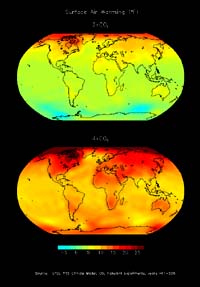
Washington - October 8, 2000 Recorded observations of how the Earth's climate has changed over the last 50 years can substantially help scientists predict future climate change, according to an international team of scientists. Using a synthesis of computer models and observed data along with a common assumption about future emissions of greenhouse gases and other pollutants, the team expects that global mean temperature in the decade 2036-2046 will be 1.8 to 4.5 degrees Fahrenheit (CONVERT) warmer than pre-industrial conditions. This temperature range can be expected to narrow as further observations become available. In a study to be published in the October 5 issue of Nature, scientists used a novel statistical technique to refine estimates of climate change produced by leading computer climate models around the world. The team, which was led by Myles Allen of Rutherford Appleton Laboratory and included Thomas Delworth of NOAA's Geophysical Fluid Dynamics Laboratory, assembled climate change projections from climate modeling centers in the United States, England, and Germany. Knowledge of how well those computer models simulated climate change that was observed over the last 50 years was used to refine forecasts of future climate change. "For the first time, we are using observations of climate change as it's happening to pin down what is likely to happen next," according to Allen. "The technique attempts to statistically compensate for inherent limitations in climate models," according to Delworth. "This technique does not, however, address uncertainties related to future emissions of greenhouse gases and other pollutants." Projections of future climate change are hindered both by uncertainties in the computer models used for such projections, as well as uncertainties in future emissions of greenhouse gases. "This study only addressed the former of those two issues." While the goal of the study was to assess the uncertainty in the projection of future climate change, the authors note that the study assumes that the general character of climate change over the next 50 years will be closely related to changes observed over the last 50 years. In addition, future emissions of greenhouse gases and other pollutants which differ from the assumptions used in this study will alter the projections of climate change. "There is clearly the potential for substantial surprises in future climate change," according to Delworth. The co-authors of the paper "Uncertainty in Forecasts of Anthropogenic Climate Change" are: Myles R. Allen, Rutherford Appleton Laboratory; Peter Stott and John Mitchell, Hadley Centre for Climate Prediction and Research; Reiner Schur, Max-Planck-Institut Fur Meteorologie; and Thomas Delworth, NOAA's Geophysical Fluid Dynamics Laboratory. Community Email This Article Comment On This Article Related Links Geophysical Fluid Dynamics Laboratory Research Reports SpaceDaily Search SpaceDaily Subscribe To SpaceDaily Express Dirt, rocks and all the stuff we stand on firmly
 Magnetic Reconnection Region Larger Than 2.5 Million Km Found In The Solar Wind
 Paris (ESA) Jan 12, 2006
Using the ESA Cluster spacecraft and the NASA Wind and ACE satellites, a team of American and European scientists have discovered the largest jets of particles created between the Earth and the Sun by magnetic reconnection. This result makes the cover of this week's issue of Nature. |
|
|

|
|
|
|
|
|
|
|
|
|
|
|
| The content herein, unless otherwise known to be public domain, are Copyright 1995-2006 - SpaceDaily.AFP and UPI Wire Stories are copyright Agence France-Presse and United Press International. ESA PortalReports are copyright European Space Agency. All NASA sourced material is public domain. Additionalcopyrights may apply in whole or part to other bona fide parties. Advertising does not imply endorsement,agreement or approval of any opinions, statements or information provided by SpaceDaily on any Web page published or hosted by SpaceDaily. Privacy Statement |