|
 |
 |
 |
 |
 |
 |
 |
 |

 |
Haze Is Heating Up The Arctic
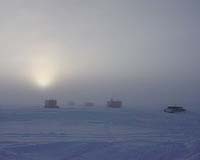
Salt Lake City (UPI) May 11, 2006 U.S. scientists in Utah say they have found yet another contributing force to polar warming: haze. Arctic climate already is known to be particularly prone to global warming caused by greenhouse gases. Now, a University of Utah study finds the Arctic haze -- consisting of particulate pollution from midlatitude cities -- mixes with thin clouds, enabling them to become more efficient at trapping heat. The effect makes the Arctic up to 3 degrees Fahrenheit warmer during polluted, cloudy episodes than it would be if the air was clean, concludes the study by Tim Garrett, an assistant professor of meteorology, and doctoral student Chuanfeng Zhao. Arctic haze has been observed since the Industrial Revolution began about 1750. Garrett said the particulate pollution modifies clouds so they warm the surface. He said the effect is most pronounced during the Arctic winter when it is dark and there is no sunlight. That's when the Arctic is most polluted because there is almost no precipitation to wash out the pollutants, and there also is a strong inversion. The study previously appeared in the April 6 issue of the journal Nature.
Source: United Press International Community Email This Article Comment On This Article Related Links - Beyond the Ice Age
 Republic Status Sought For Emerging Arctic Islet
 Oslo (SPX) May 11, 2006
A British artist announced plans Wednesday to establish a republic on an Arctic island the size of a football pitch created by global warming. |
|
|

| The content herein, unless otherwise known to be public domain, are Copyright 1995-2006 - SpaceDaily.AFP and UPI Wire Stories are copyright Agence France-Presse and United Press International. ESA PortalReports are copyright European Space Agency. All NASA sourced material is public domain. Additionalcopyrights may apply in whole or part to other bona fide parties. Advertising does not imply endorsement,agreement or approval of any opinions, statements or information provided by SpaceDaily on any Web page published or hosted by SpaceDaily. Privacy Statement |