|
 |
 |
 |
 |
 |
 |
 |
 |

 |
Hayabusa Team Trying To Restore Communications With Spacecraft
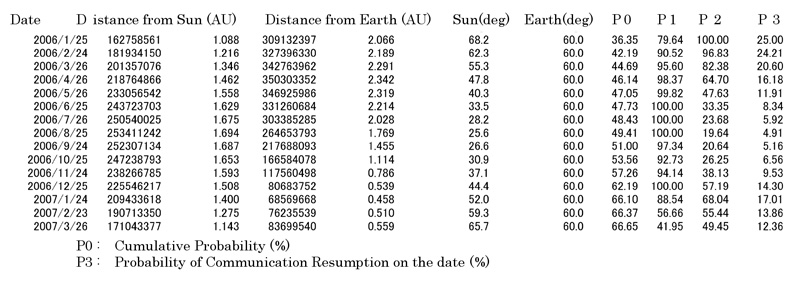
Tokyo, Japan (SPX) Dec 16, 2005 The Hayabusa spacecraft is currently undergoing recovery operations to resume communication with ground stations on Earth after being hit by an abrupt torque, caused by the fuel leak that occurred a few days earlier, that has put it out of ground contact since December 9. The project team expects to resume communication with the spacecraft soon. However, we are not so sure now if we can get the spacecraft to return to earth by June 2007 and have decided to lengthen the flight period by three more years so that it returns in June 2010. On December 8, the Usuda station observed sudden shifts of the range-rate measurements at 4:13 UTC with the corresponding gradual decrease of signal intensity AGC (Automated Gain Controller) read. The slow measurement and the intensity change are due to the out-gassing effect that derived from the fuel leak that occurred on November 26 and 27. Since the beacon signal communication resumed on November 29, the project has made an effort to exclude the vapor gas of the fuel from the spacecraft. The project has now identified the out-gassing has successfully been performed, as its exponential acceleration decay has shown so far. On December 8, the spacecraft was under the resume operation phase for the chemical propulsion, and was given a slow spin for a period of about six minutes. From the beginning of December, the project has introduced the Xenon gas thruster control strategy for emergency, replacing the chemical propulsion system. But its control capability was not enough strong for the spacecraft to withstand the disturbance on December 8. Current estimates say the spacecraft may be in a large coning motion, and that is why the spacecraft has not responded to commands sent from the ground station. The spacecraft has been out of communication since December 9. Analysis predicting the attitude property relating to both the Sun and Earth shows that there will be a high possibility of the resumption of communication from Earth in the next few months ahead. However, the spacecraft may have to undergo another long term baking cycle before it starts the return cruise operation using onboard ion engines. It's concluded that the commencement of the return cruise during December will be difficult. The project team has therefore determined that the return cruise should start from 2007, so the spacecraft can return to Earth in June of 2010, three years later than the original plan. The spacecraft operation will shift from the normal mode to the rescue mode for up to a year. Long term prediction indicate a high probability of having the spacecraft communicate with the ground station again, with the spacecraft captured well within the beam width of the Usuda deep space antenna. The spacecraft will take advantage of Xenon gas attitude control again after enough baking operation time. The remaining Xenon gas is adequate for the return cruise for ion engines on Hayabusa. The Hayabusa web page will report any updates, as soon as they become available.
(Supplement) Hayabusa Rescue Operation The Hayabusa spacecraft is designed to allow the spin-stabilization and attitude to converge to a certain pure spin around its high gain antenna axis. Regarding the current state affected by the disturbance on December 8, the attitude is conceived not to meet either the Sun or Earth geometry requirements in terms of power and communication. Once the coning motion damps, there will be some probability that the spacecraft spin attitude satisfies both the power and communication conditions in several months. A long term prediction is given, Reference-1, which infers the probability is well assured for the resumption. There will be a small chance that the spacecraft position will be out of the deep space antenna beam width for at least several months. The Hayabusa system is designed to be initialized even when the whole power is down. Actually, on November 29, the Hayabusa system restarted, and these procedures functioned as prescribed. A new trajectory synthesis that makes the spacecraft return to the earth in June of 2010 is shown here. Without immediate communication resumption, the project team thinks it should take this new schedule soon. Community Email This Article Comment On This Article Related Links JAXA SpaceDaily Search SpaceDaily Subscribe To SpaceDaily Express Asteroid and Comet Mission News, Science and Technology
 NASA'S Spitzer Finds Possible Comet Dust Around Dead Star
 Pasadena CA (SPX) Jan 12, 2006
NASA's Spitzer Space Telescope has spotted what may be comet dust sprinkled around the white dwarf star G29-38, which died approximately 500 million years ago. |
|
|

| The content herein, unless otherwise known to be public domain, are Copyright 1995-2006 - SpaceDaily.AFP and UPI Wire Stories are copyright Agence France-Presse and United Press International. ESA PortalReports are copyright European Space Agency. All NASA sourced material is public domain. Additionalcopyrights may apply in whole or part to other bona fide parties. Advertising does not imply endorsement,agreement or approval of any opinions, statements or information provided by SpaceDaily on any Web page published or hosted by SpaceDaily. Privacy Statement |