|
 |
 |
 |
 |
 |
 |
 |
 |

 |
Has The Mariner Meteor Mystery Been Solved
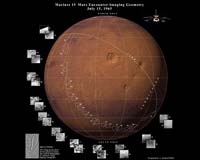
for NASA Science News Huntsville AL (SPX) Aug 24, 2006 On July 14, 1965, Mariner 4 swooped over Mars. It was a moment of high drama. Six other probes had already tried to reach the red planet and failed. Since the days of H.G. Wells (War of the Worlds, 1898), people had been hearing about life on Mars, and they were ready to see the canals and cities. The wait was becoming excruciating. Finally, all was revealed. With flawless precision, Mariner 4 dipped less than 10,000 km above the planet's surface and took 22 pictures. Mars was covered with desert sand and ancient craters. No cities. No canals. No Martians. No one would ever look at the red planet the same way again. Most histories of the mission end right there, with Mariner 4 buzzing Mars-"the first spacecraft to visit the red planet"-- and throwing cold water on a lot of good science fiction. But there's more to the story. After the flyby, something strange happened to Mariner 4, setting the stage for a 40-year mystery: Fast-forward to September 15, 1967. Mariner 4 was cruising the dark emptiness between Earth and Mars. Having shot past Mars in '65 without enough fuel to turn around and go back, there was nothing else to do. All was quiet. Fuel was running low. Soon, Mariner 4 would fade into history. That's when the meteor storm hit. "For about 45 minutes the spacecraft experienced a shower of meteoroids more intense than any Leonid meteor storm we've ever seen on Earth," according to Bill Cooke, the head of NASA's Meteoroid Environment Office in Huntsville, AL. The impacts ripped away bits of insulation and temporarily changed the craft's orientation in space. "It was a complete surprise." Think about it. Out in the "emptiness" between Earth and Mars, a region of space astronauts are going cross one day if NASA's Vision for Space Exploration comes to fruition, lurks a dark stream of meteoroids capable of producing a shower more intense than anything we've seen in centuries of sky watching on Earth. "Until Mariner 4 stumbled onto it," says Cooke, "we had no idea it was there." For almost 40 years the source of the shower remained a mystery. But now, meteor expert Paul Weigert of the University of Western Ontario may have cracked the case. The culprit, he believes, is a "dark comet" named D/1895 Q1 (Swift) or "D/Swift" for short. "Comet D/Swift was first seen in August 1895 by the prolific comet hunter Lewis A. Swift," says Weigert. Swift discovered or co-discovered more than a dozen comets, including 109P/Swift-Tuttle, the source of the well-known Perseid meteor shower. Unlike his other comets, however, "D/Swift quickly vanished. The comet was last spotted in February 1896 heading out of the inner Solar System, and it has never been seen since, even though its orbit indicates it should come back and brighten every 5 years or so." (Note that the prefix D/ indicates a lost or broken-up comet, one that was well-observed on one or more occasions, but which failed to reappear as expected.) What happened to D/Swift? "The comet may have disintegrated," says Weigert. Comets are notoriously fragile and sometimes a little sunlight is all it takes to make them crumble. Comet D/Swift probably overheated when it passed by the sun in 1895 and later fell apart. D/Swift was mostly forgotten until last year when Bill Cooke wondered if "some old D/ comet" might be responsible for the Mariner 4 episode. Comets, especially disrupted comets, leave a stream of debris in their wake as they orbit the sun. If Mariner 4 passed through such a stream, "it would have been sandblasted." He asked Weigert, a friend and colleague, to look into it. Weigert began to examine old comet data and-voil�-"Mariner 4 was close to the orbit of Comet D/Swift at the time of the meteor encounter." Amazingly, Mariner 4 was not merely close to the comet's orbit, it may have been close to the comet itself. "According to our calculations, the [possibly shattered] nucleus of D/Swift was only 20 million kilometers from the spacecraft." As distances go in the solar system, that's nearby. "It's like in Star Trek when Enterprise stumbles across a comet in the middle of deep space. Of course, that's crazy," says Cooke. "Space is so big, the chances of running across a comet are almost nil." Yet this may be what happened to Mariner 4. Mariner's cameras weren't turned on at the time, so a comet could've passed by unnoticed-except for the jostling of comet dust. Telescopes on Earth saw nothing, but that's no surprise. An old, shattered nucleus wouldn't necessarily glow. It all makes sense.
Case closed? Weigert still has doubts. "The complicating factor is that, because D/Swift was seen for only a short time in 1895-96, its orbit is not terribly well-known. Our extrapolations could be wrong. We're in the process of collecting more observations from 19th century archives and re-analyzing them. Soon, I hope there will be enough information to convict or acquit Comet D/Swift." This investigation may lead to others. "The space between Earth and Mars is probably criss-crossed by old debris streams," says Cooke. Weigert's methods can be used to find some of them, "so the next meteor storm won't be such a surprise." Community Email This Article Comment On This Article Related Links Rocket Science News at Space-Travel.Com Mars News and Information at MarsDaily.com Lunar Dreams and more
 Opportunity Observes Isabela
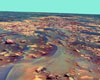 Pasadena CA (SPX) Aug 23, 2006
Opportunity is healthy and on the road to "Victoria Crater." Spirit drove 35.67 meters (117 feet) from "Beagle Crater" to a small sand dune, or ripple, to examine the dune with the robotic arm. The ripple study included observations with the microscopic imager, two alpha particle X-ray spectrometer integrations, and two observations with the miniature thermal emission spectrometer. |
|
|

| The content herein, unless otherwise known to be public domain, are Copyright 1995-2006 - SpaceDaily.AFP and UPI Wire Stories are copyright Agence France-Presse and United Press International. ESA PortalReports are copyright European Space Agency. All NASA sourced material is public domain. Additionalcopyrights may apply in whole or part to other bona fide parties. Advertising does not imply endorsement,agreement or approval of any opinions, statements or information provided by SpaceDaily on any Web page published or hosted by SpaceDaily. Privacy Statement |