|
 |
 |
 |
 |
 |
 |
 |
 |

 |
Harvard, Texas A&M Scientists Develop New Laser
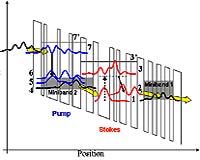
College Station TX (SPX) Mar 24, 2005 Engineers and applied physicists have laid the foundations for a new type of "plug and play" laser - the Raman injection laser - and in the process, several key innovations in laser technology. The device combines the advantages of nonlinear optical devices and semiconductor injection lasers with a compact design, and may one day lead to wide-ranging applications in imaging and detection. Published in the Feb. 24th issue of Nature, the proof of concept model was developed by Mariano Troccoli, Ertugrul Cubukcu and Federico Capasso of the Harvard University Division of Engineering and Applied Sciences; Alexey Belyanin of Texas A&M University; and Deborah L. Sivco and Alfred Y. Cho of Bell Laboratories, Lucent Technologies. The finding was supported in part by Texas A&M's Telecommunications and Informatics Task Force Initiative. Conventional Raman lasers depend on a fundamental phenomenon in physics called the Raman effect-the change in the frequency of monochromatic light (such as a laser) when it passes through a substance. When light from an intense exciting laser beam, known as the "pump," deflects off the molecules of certain materials, some of the incident photons lose part of their energy. As a result, a secondary laser beam with a frequency shifted from that of the exciting laser emerges from the material. "Raman lasers have been used for a long time," Troccoli says. "In general they require a large and powerful external pump to compensate for the beam's attenuation, or weakening, as it propagates through the material. In our work, we were able to put the pump and the material itself into a single device." The team's ability to combine the power source and the Raman material together, literally creating a laser-within-a-laser, has resulted in several key innovations. The injection laser is the first current-driven Raman laser; in essence, it can be plugged in. The current generates an internal laser beam (the pump) within the material, which, in turn, generates the Raman laser radiation. Because the pump laser is self-generated, the device is highly efficient, with 30 percent of the pump power converted into the Raman laser beam. "This 'matryoshka' design, nesting a layer within a layer, enables a crucial physical innovation," explains Belyanin, who co-authored key theoretical ideas for laying in the foundation of the novel devices and has been collaborating with Capasso's group on their implementation since 2001. "Now the pump laser radiation can be tuned to a strong electronic resonance in the material. This boosts the gain for the Raman laser by five orders of magnitude, as compared to conventional Raman sources, in which the resonance had to be avoided because of strong absorption." In addition to being more efficient, the device is also very compact. Despite its small size, however, it packs a powerful punch. "Everything is contained in one single cavity only a few microns wide and a couple millimeters in length," says Capasso, who co-developed the groundbreaking Quantum Cascade laser more than a decade ago. "This means there's a very strong interaction and that you do not need a very high-powered source to get the desired effect." As a result, the apparatus needed to generate the laser can be made much smaller, with a footprint of less than one millimeter. This is comparable to the size of commercial diode lasers that are found in everyday applications such as DVD players and bar-code readers or used by physicians for procedures such as laser eye correction. The new device was created using Molecular Beam Epitaxy (MBE), the thin film growth technique pioneered by Bell Laboratories' Cho in the late 1960s that is now widely used in commercial products such as lasers for CD players. In MBE atoms are "spray painted" on a substrate to produce semiconductor films only a few atomic layers thick. "Perhaps what's most important is that the new laser is not dependent on the conventional Raman shift," Troccoli notes. "Instead, we use an internal electronic oscillation mode that can be designed or tailored over a broad range by changing the layer thickness of the constituent materials. This makes the device far more flexible and allows us to use it in room temperature conditions. "We can design it to emit in the mid-infrared range, where most molecules have their telltale absorption 'fingerprints,' and eventually broaden it to work in the Terahertz range (a wavelength between 3 and .003 millimeters), where many materials appear transparent." Although the current version of the injection laser is not as powerful as standard Raman lasers, it overcomes fundamental barriers to practical use. Ultimately, by better understanding the physics involved and improving the device's design, the researchers hope their work will lead to a new generation of "tunable" compact lasers that can operate at almost any wavelength of the invisible light spectrum, including the Terahertz range. Because Terahertz radiation can easily penetrate through packages and clothing, they may also have broad future potential applications related to areas such as homeland security. "While our paper merely has demonstrated proof of concept, one day it may lead to the sort of security experts dream of having-a portable device that you could use to detect things like weapons or explosives simply by shining an invisible light to see what someone might be hiding," Capasso explains. "The work also represents an important advance in quantum design, since we are now able to engineer, from the bottom-up, a new Raman material and laser and tailor its property for a given application." According to Belyanin, the same strategy of integrated quantum design can be applied to a variety of other nonlinear optical sources, paving the way for even greater ramifications of the discovery. Community Email This Article Comment On This Article Related Links Texas A&M University SpaceDaily Search SpaceDaily Subscribe To SpaceDaily Express Space Technology News - Applications and Research
 LIGO Up And Running, But Gravity Waves Remain Elusive
 Washington DC (SPX) Jan 10, 2006
Scientists working on the Laser Interferometer Gravitational-Wave Observatory said Monday the facility has reached its target detection sensitivity, but the goal of finding the elusive phenomena known as gravity waves remains as elusive as ever. |
|
|

| The content herein, unless otherwise known to be public domain, are Copyright 1995-2006 - SpaceDaily.AFP and UPI Wire Stories are copyright Agence France-Presse and United Press International. ESA PortalReports are copyright European Space Agency. All NASA sourced material is public domain. Additionalcopyrights may apply in whole or part to other bona fide parties. Advertising does not imply endorsement,agreement or approval of any opinions, statements or information provided by SpaceDaily on any Web page published or hosted by SpaceDaily. Privacy Statement |