|
 |
 |
 |
 |
 |
 |
 |
 |

 |
Harvard Scientists Create High-Speed Integrated Nanowire Circuits
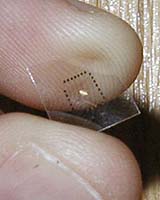
Cambridge MA (SPX) May 2, 2005 Chemists and engineers at Harvard University have made robust circuits from minuscule nanowires that align themselves on a chip of glass during low-temperature fabrication, creating rudimentary electronic devices that offer solid performance without high-temperature production or high-priced silicon. The researchers, led by chemist Charles M. Lieber and engineer Donhee Ham, produced circuits at low temperature by running a nanowire-laced solution over a glass substrate, followed by regular photolithography to etch the pattern of a circuit. Their merging of low-temperature fabrication and nanowires in a high-performance electronic device is described this week in the journal Nature. "By using common, lightweight and low-cost materials such as glass or even plastic as substrates, these nanowire circuits could make computing devices ubiquitous, allowing powerful electronics to permeate all aspects of living," says Lieber, the Mark Hyman Jr. Professor of Chemistry in Harvard's Faculty of Arts and Sciences. "Because this technique can create a high-quality circuit at low temperatures, it could be a technology that finally decouples quality electronics from single crystal silicon wafers, which are resilient during high-temperature fabrication but also very expensive." Lieber, Ham and colleagues used their technique to produce nanowire-based logical inverters and ring oscillators, which are inverters in series. The ring oscillator devices, which are critical for virtually all digital electronics, performed considerably better than comparable ring oscillators produced at low temperatures using organic semiconductors, achieving a speed roughly 20 times faster. The nanowire-derived ring oscillators reached a speed of 11.7 megahertz, outpacing by a factor of roughly 10,000 the excruciatingly slow performance attained by other nanomaterial circuits. "These nanowire circuits' performance was impressive," says Ham, assistant professor of electrical engineering in Harvard's Division of Engineering and Applied Sciences. "This finding gives us confidence that we can ramp up these elementary circuits to build more complex devices, which is something we now plan to do." Lieber and Ham say these functional nanowire circuits demonstrate nanomaterials' potential in electronics applications. The circuits could be used in devices such as low-cost radio-frequency tags and fully integrated high-refresh-rate displays, the scientists write in Nature; on a larger scale, such circuits could provide a foundation for more complex nanoelectronics. The technique Lieber and Ham used to produce a nanowire-based circuit on a glass substrate is also compatible with other commonplace materials such as plastics, broadening its potential applicability. Community Email This Article Comment On This Article Related Links Lieber Research Group Harvard University SpaceDaily Search SpaceDaily Subscribe To SpaceDaily Express Space Technology News - Applications and Research
 Industry Team Achieve New Communications Technology With AESA Radars
 Baltimore MD (SPX) Jan 12, 2006
A team comprised of three leading US aerospace and defense contractors has demonstrated an innovative technological use of active electronically scanned array (AESA) radars for high-bandwidth communications. |
|
|

| The content herein, unless otherwise known to be public domain, are Copyright 1995-2006 - SpaceDaily.AFP and UPI Wire Stories are copyright Agence France-Presse and United Press International. ESA PortalReports are copyright European Space Agency. All NASA sourced material is public domain. Additionalcopyrights may apply in whole or part to other bona fide parties. Advertising does not imply endorsement,agreement or approval of any opinions, statements or information provided by SpaceDaily on any Web page published or hosted by SpaceDaily. Privacy Statement |