|
 |
 |
 |
 |
 |
 |
 |
 |

 |
Harnessing Flea Power To Create Near-Perfect Rubber
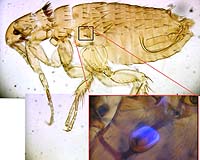
Canberra (SPX) Oct 17, 2005 In a world first, CSIRO scientists have copied nature to produce a near-perfect rubber from resilin, the elastic protein which gives fleas their remarkable jumping ability and helps insects fly. This important research breakthrough is reported in the latest edition of the respected international journal Nature (13 October 2005). Resilin has a near-perfect capacity to recover, or 'bounce back', after stress is applied and extraordinary durability, which may have applications in industry and medicine. It could be used as a high-efficiency rubber in industry, spinal disc implants, heart and blood valve substitutes, and perhaps even to add some extra spring to the heels of running shoes. "Resilin has evolved over hundreds of millions of years in insects into the most efficient elastic protein known," says project leader, CSIRO Livestock Industries principal scientist, Dr Chris Elvin. "Everyone knows fleas jump like crazy and now, for the first time, we have replicated the material that enables them to do that." If humans could jump like fleas, we would be able to leap 100-story buildings. The durability and elasticity of resilin helps insects fly, enabling bees to flap their wings in almost frictionless motion 500 million times in a lifecycle. "The resilin gene is turned off in adult insects, so there is no way of renewing their supplies," Dr Elvin says. "If you consider the number of contraction and extension cycles that resilin must accomplish during the course of an insect's life, the fatigue lifetime of the material is extraordinary. "Spinal disc implants need to last for 100 million cycles, which is roughly how many times we move our back in a lifetime, and we know resilin can last that long." Dr Elvin's multi-disciplinary research team achieved a number of firsts with the research, which was funded by a CSIRO Emerging Sciences Area grant. They were the first to clone a portion of the 'resilin gene' in the fruitfly and express it in bacteria as a soluble protein. The team had, for the first time in the world, produced resilin protein in purified form. The next challenge was to develop a technique to turn the soluble material into a solid form. "Using a process we have patented, we developed a resilin rubber material which structural testing showed had a near-perfect resilience," Dr Elvin says. In another first the team developed a method of measuring resilience at the nano-scale by making use of the unique capabilities of an atomic force microscope. This material displayed a 97 per cent recovery after stress was applied, far exceeding that of synthetic polybutadiene 'superball' high-resilience rubber (80 per cent) and elastin � an elastic protein in humans which accounts for the elasticity of structures such the skin, blood vessels, heart, lungs, intestines, tendons, and ligaments (90 per cent). Led by CSIRO Livestock Industries, the resilin project involved specialised input from CSIRO's Divisions of Textile Fibre Technology, Manufacturing and Infrastructure Technology and Molecular and Health Technologies. Other key collaborators include the University of Queensland, Monash University and the Australian National University. Community Email This Article Comment On This Article Related Links CSIRO SpaceDaily Search SpaceDaily Subscribe To SpaceDaily Express Space Technology News - Applications and Research
 NGC Chosen To Proceed With Developing Solid-State Laser Technology For Military Applications
 Redondo Beach CA (SPX) Jan 09, 2006
Northrop Grumman Corporation has been selected to develop "military-grade," solid-state laser technology that is expected to pave the way for the U.S. military to incorporate high-energy laser systems across all services, including ships, manned and unmanned aircraft, and ground vehicles. |
|
|

| The content herein, unless otherwise known to be public domain, are Copyright 1995-2006 - SpaceDaily.AFP and UPI Wire Stories are copyright Agence France-Presse and United Press International. ESA PortalReports are copyright European Space Agency. All NASA sourced material is public domain. Additionalcopyrights may apply in whole or part to other bona fide parties. Advertising does not imply endorsement,agreement or approval of any opinions, statements or information provided by SpaceDaily on any Web page published or hosted by SpaceDaily. Privacy Statement |