|
 |
 |
 |
 |
 |
 |
 |
 |

 |
Harbin Residents Get Water Back After Toxic Spill
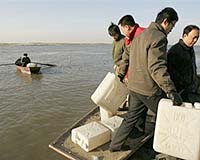
Harbin, China(AFP) Nov 25, 2005 Authorities in the Chinese city of Harbin restored running water to its 3.8 million residents Sunday, five days after supplies were cut off due to a massive toxic spill in the city's river, state media said. The governor of Heilongjiang province, Zhang Zuoji, took the first drink of city water in Harbin, the provincial capital, after supplies were restored at 6:00 pm (1000 GMT), Xinhua news agency reported. "The water is a little bit hot but tastes very sweet," he said after taking a sip of hot water. He told Xinhua his action was "meant to reassure the public and dispel their worries." Some 100 tons of benzene were dumped into the Songhua river, which runs through Harbin, on November 13 after a huge explosion at a chemical plant in Jilin province, some 380 kilometers (235 miles) up river from the city. Public water supplies to Harbin were cut on Tuesday as the government scrambled to bring in massive shipments of bottled water to avoid a public health crisis. Water samples taken in the city now show no trace of the chemical, Xinhua quoted local officials as saying Sunday. "The nitrobenzene level has met the national standard with a concentration of 0.0050 milligrams/liter," the agency said, quoting Lin Qiang, spokesman for the Heilongjiang Provincial Environmental Protection Bureau. The city will launch a three-color water quality warning system to ensure the health of city residents, Xinhua said, adding that the local media would be used to keep city dwellers informed. Red indicates the water is not suitable for any use, yellow that it can be used but not for drinking, and green it is suitable for all purposes, the report said. Premier Wen Jiabao, who arrived in Harbin Saturday, ordered officials to begin directing their attention toward the lower reaches of the Songhua, where the 80-kilometer toxic slick was heading after passing through Harbin. He insisted that pollution levels should be promptly and publicly reported. "Local governments must follow the polluted waters through the cities, towns and villages along the river and make prompt public reports on the monitoring results," Wen was quoted by the Heilongjiang Morning Post as telling officials. "Every available measure must be taken to ensure the drinking needs of the people and the quality of the water." Following the blast at a PetroChina benzene plant, officials in Jilin province covered up the water pollution disaster for 10 days. The calamity has been widely seen as a reflection of China's increasingly dismal environmental situation, which has been largely ignored during 25 years of fast-paced economic growth. "Since the reform and opening began we have made huge accomplishments in the development of our economy and society, but this has come at a huge price to the environment," Zhang told Xinhua in an interview. "The nature of this incident may appear to have been accidental, but from the background circumstances this was unavoidable," said the provincial governor. Despite panic buying of water and food supplies in Harbin last weekend, the city responded to the crisis rather calmly, with the government reporting zero cases of benzene poisoning and no pollution-related fatalities. Wen further ordered officials in Heilongjiang to report on river monitoring efforts to their Russian neighbors. China has formally apologized to its neighbor for the benzene spill, now heading for the Amur river -- known in China as the Heilong -- on their common border. The polluted Songhua is a major tributary of the Amur. On Saturday in Beijing, Chinese Foreign Minister Li Zhaoxing informed Russian ambassador Sergei Razov about the river pollution and expressed regret over possible harm to the Russian people. The slick was expected to reach Russia within days. Russia has shipped extra stocks of purified water to the eastern city of Khabarovsk which lies downstream from the toxic spill but officials said Sunday that tests showed the water supply was so far unaffected. Oleg Mitvol, an official with the Khabarovsk regional emergency situations department, said tests showed no increase in river water toxin levels while the city's water purification facilities were functioning normally, Interfax news agency reported. Despite its booming economy and rising living standards, China is facing a water crisis due to severe shortages caused by heavy pollution. Community Email This Article Comment On This Article Related Links SpaceDaily Search SpaceDaily Subscribe To SpaceDaily Express Our Polluted World and Cleaning It Up
 Toxin Level In Chinese River Still Unsafe
 Beijing (AFP) Jan 11, 2006
Levels of a cancer-causing chemical found in a Chinese river are still above safety standards after a spill last week, despite earlier official reassurances, state media reported Wednesday. |
|
|

| The content herein, unless otherwise known to be public domain, are Copyright 1995-2006 - SpaceDaily.AFP and UPI Wire Stories are copyright Agence France-Presse and United Press International. ESA PortalReports are copyright European Space Agency. All NASA sourced material is public domain. Additionalcopyrights may apply in whole or part to other bona fide parties. Advertising does not imply endorsement,agreement or approval of any opinions, statements or information provided by SpaceDaily on any Web page published or hosted by SpaceDaily. Privacy Statement |