|
 |
 |
 |
 |
 |
 |
 |
 |

 |
Half Of Tsunami Donations Still Unused
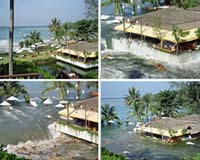
London (AFP) Dec 19, 2006 About half of the billions of dollars donated by individuals, companies and governments worldwide to help the victims of the southeast Asian tsunami two years ago has still not been spent, the BBC said on Tuesday. According to figures obtained by the broadcaster from a database compiled by the United Nations Department for Aid and Development, several foreign governments have also only given only a small proportion, and at times none, of the money they promised. Of the 6.7 billion dollars (5.1 billion euros) pledged, about a tenth has yet to be delivered, and only 3.4 billion dollars has been spent thus far, the BBC said. Among the countries that came up with a fraction of what they promised, China offered 301 million dollars to help Sri Lanka recover from the disaster, but has thus far delivered just one million dollars, the broadcaster said. Spain pledged 60 million dollars to Sri Lanka, but came up with less than a million, while France said it would give 79 million dollars, but delivered just over a million dollars. Kuwait had pledged slightly less than 10 million dollars to the Maldives, but has yet to actually hand over any money. The United States has given about 38 percent of the money it promised, according to the UN figures. The European Commission owes about 70 million dollars, and Britain 12 million. The broadcaster said on its website that about nine percent of the total money pledged was not yet delivered. The BBC said that of the 2.2 billion dollars donated to the Red Cross worldwide in the aftermath of the disaster, about 1.3 billion dollars had not yet been spent, and of the 50,000 homes promised by the Red Cross, just 8,000 had been finished. Speaking to the BBC, the international director for the British Red Cross defended its performance: "It sounds bad, but I think it needs to be put into context." "It is incredibly difficult ... we said from the beginning, this is happening in very difficult circumstances. We raised the money knowing it was difficult. It will take time to spend this money in a responsible manner," Matthias Schmale said. He said that the British Red Cross had thus far finished 16 of the 2,000 homes it had promised, with 265 ready to be handed over, and a further 400 would have their foundation laid by the end of this month. "I know this sounds like slow progress ... When the tsunami swept away houses, it also swept away identity papers, legal plot papers, etc. We have taken almost a year to help people back ... to make sure they have legal ownership of their plots," he said. The UN's special rapporteur on adequate housing Miloon Kothari was unimpressed by the reasons for delays in building housing, telling the BBC: "It should really not take this long to build permanent housing. "I do not accept the explanation that it is going to take four to five years, in some cases, seven. I'm an architect, I know how long it takes to build a house." Early on December 26, 2004, a magnitude 9.3 earthquake off the Indonesian island of Sumatra triggered an ocean-wide tsunami that killed 220,000 people.
Source: Agence France-Presse Community Email This Article Comment On This Article Related Links United Nations Department for Aid and Development Bring Order To A World Of Disasters Bringing Order To A World Of Disasters A world of storm and tempest When the Earth Quakes
 Fund To Build 46,000 Homes, Shelters For Indonesian Java Quake Victims
 Jakarta (AFP) Dec 20, 2006
A project to build 21,500 permanent houses and 24,500 temporary shelters for victims of the Java earthquake and tsunami was launched Wednesday, the World Bank said. Some 6,000 people were killed and 300,000 homes destroyed or seriously damaged in the May 27 quake which hit the ancient city of Yogyakarta and its surrounding area. More than 600 were killed in the July tsunami which hit the southern coast of Java. |
|
|

| The content herein, unless otherwise known to be public domain, are Copyright 1995-2006 - SpaceDaily.AFP and UPI Wire Stories are copyright Agence France-Presse and United Press International. ESA PortalReports are copyright European Space Agency. All NASA sourced material is public domain. Additionalcopyrights may apply in whole or part to other bona fide parties. Advertising does not imply endorsement,agreement or approval of any opinions, statements or information provided by SpaceDaily on any Web page published or hosted by SpaceDaily. Privacy Statement |