|
 |
 |
 |
 |
 |
 |
 |
 |

 |
Half-Century Old Moon Mystery Solved
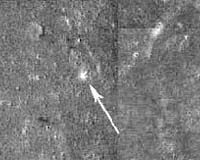
Pasadena - Feb 21, 2003 In the early morning hours of Nov. 15, 1953, an amateur astronomer in Oklahoma photographed what he believed to be a massive, white-hot fireball of vaporized rock rising from the center of the moon's face. If his theory was right, Dr. Leon Stuart would be the first and only human in history to witness and document the impact of an asteroid-sized body impacting the moon's scarred exterior. Almost a half-century, numerous space probes and six manned lunar landings later, what had become known in astronomy circles, as "Stuart's Event" was still an unproven, controversial theory. Skeptics dismissed Stuart's data as inconclusive and claimed the flash was a result of a meteorite entering Earth's atmosphere. That is, until Dr. Bonnie J. Buratti, a scientist at NASA's Jet Propulsion Laboratory (JPL) in Pasadena, and Lane Johnson of Pomona College, Claremont, Calif., took a fresh look at the 50-year- old lunar mystery. "Stuart's remarkable photograph of the collision gave us an excellent starting point in our search," said Buratti. "We were able to estimate the energy produced by the collision. But we calculated that any crater resulting from the collision would have been too small to be seen by even the best Earth-based telescopes, so we looked elsewhere for proof." Buratti and Lane's reconnaissance of the 35-kilometer (21.75- mile) wide region where the impact likely occurred led them to observations made by spacecraft orbiting the moon. First, they dusted off photographs taken from the Lunar Orbiter spacecraft back in 1967, but none of the craters appeared a likely candidate. Then they consulted the more detailed imagery taken from the Clementine spacecraft in 1994. "Using Stuart's photograph of the lunar flash, we estimated the object that hit the moon was approximately 20 meters (65. 6 feet) across, and the resulting crater would be in the range of one to two kilometers (.62 to 1.24 miles) across. We were looking for fresh craters with a non-eroded appearance," Buratti said. Part of what makes a moon crater look "fresh" is the appearance of a bluish tinge to the surface. This bluish tinge indicates lunar soil that is relatively untouched by a process called "space weathering," which reddens the soil. Another indicator of a fresh crater is that it reflects distinctly more light than the surrounding area. Buratti and Lane's search of images from the Clementine mission revealed a 1.5-kilometer (0.93 mile) wide crater. It had a bright blue, fresh-appearing layer of material surrounding the impact site, and it was located in the middle of Stuart's photograph of the 1953 flash. The crater's size is consistent with the energy produced by the observed flash; it has the right color and reflectance, and it is the right shape. Having the vital statistics of Stuart's crater, Buratti and Lane calculated the energy released at impact was about .5 megatons (35 times more powerful than the Hiroshima atomic bomb). They estimate such events occur on the lunar surface once every half-century. "To me this is the celestial equivalent of observing a once- in-a-century hurricane," observed Buratti. "We're taught the moon is geologically dead, but this proves that it is not. Here we can actually see weather on the moon," she said. While Dr. Stuart passed on in 1968, his son Jerry Stuart offered some thoughts about Buratti and Lane's findings. "Astronomy is all about investigation and discovery. It was my father's passion, and I know he would be quite pleased," he said. Buratti and Lane's study appears in the latest issue of the space journal, Icarus. Community Email This Article Comment On This Article Related Links Clementine Lunar Image Browser SpaceDaily Search SpaceDaily Subscribe To SpaceDaily Express Asteroid and Comet Impact Danger To Earth - News and Science
 Variety Couldn't Save The Dinosaurs
 Kingston RI (SPX) Nov 19, 2004
When dinosaurs became extinct from the effects of a massive asteroid hitting Earth 65 million years ago, there were more varieties of the reptiles living than ever before, according to a new analysis of global fossil records by a team of researchers led by a University of Rhode Island paleontologist. |
|
|

| The content herein, unless otherwise known to be public domain, are Copyright 1995-2006 - SpaceDaily.AFP and UPI Wire Stories are copyright Agence France-Presse and United Press International. ESA PortalReports are copyright European Space Agency. All NASA sourced material is public domain. Additionalcopyrights may apply in whole or part to other bona fide parties. Advertising does not imply endorsement,agreement or approval of any opinions, statements or information provided by SpaceDaily on any Web page published or hosted by SpaceDaily. Privacy Statement |