|
 |
 |
 |
 |
 |
 |
 |
 |

 |
HISPASAT Chooses Arianespace To Launch The Amazonas 2 Satellite
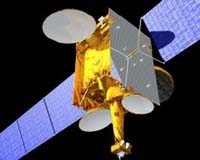
Madrid, Spain (SPX) Dec 14, 2007 HISPASAT has awarded Arianespace the launching of their new communications satellite, the Amazonas 2, which will be situated in the orbital position 61 West. With this new launch, planned for 2009, the group takes one more step in the process of growth and consolidation of this orbital position. Amazonas 2 will be the fifth satellite launched by Arianespace, who also sent the satellites Hispasat 1 A and Hispasat 1 B into space in 1992 and 1993 respectively, and in 2005 and 2006, they launched the government communications satellites Xtar-Eur and Spainsat. With this new launch, which will take place with an Ariance 5 ECA launching vehicle from the base of the French Guayana European Space Agency in Kourou, HISPASAT renews its confidence in Arianespace as a company of well-known prestige within the sector of providers of geostation satellite launching services. According to the President of HISPASAT, Petra Mateos "with the awarding of the launching contract of Amazonas 2, HISPASAT continues with a plan of growth and expansion, started a year ago, and with the group it will duplicate its spatial capacity for America and will achieve a meaningful improvement for the satellite operators". Mateos also highlighted that "with the satellite Amazonas 2 HISPSAT will strengthen its leadership in America where, since the signing of important agreements with the main telecommunications and digital platforms operators, its has already become a high quality leading operator due to its high quality and elevated technological value of the services provided and the solutions developed in the la I+D+i" field. Amazonas 2, whose construction was awarded in June 2007 to EADS-ASTRIUM, will have an operational life of 15 years and will give fixed communications and radio-diffusion services by means of a total of 64 simultaneous transponders, of which 54 will operate in band Ku and 10 in band C. The satellite will have a launching mass of 5.5 tons, a solar panel opened out in orbit of more than 39 metres and a power of 14kW at the end of its operational life. With this new satellite, whose total estimated investment exceeds 200 million euros, HISPASAT will have a new and competitive communications capacity in Iberoamerica, in the traditional business field of renting spatial capacity as well as in fields related to projects involved with technological innovation. As with the rest of the satellites in the HISPASAT fleet, the manufacturing of Amazonas 2 relies on a noticeable participation from the Spanish aerospace industry. EADS CASA Espacio will be responsible for the antennas for the reception and transmission of communications signals to Earth. In the communications repeater, Thales Alenia Space Espana, Rymsa and Mier will construct various radiofrequency equipments and finally, on the platform field, Astrium Crisa will be responsible for manufacturing various electronic equipments for controlling the actuators and pyrotechnic devices. Amazonas 2 incorporates a new version of the intelligent processor Amerhis in its configuration for the provision of advanced broadband services. The first version, loaded successfully in the Amazonas satellite, has had a very good reception from the clients of the group who have seen how the HISPASAT satellites have changed from being transparent repeaters to become intelligent systems capable of processing and regenerating the signals on board, without the need for HUB on Earth. Thanks to Amerhis' provisions, the HISPSAT clients can access new services. Amongst these, the corporate services to small and medium sized companies stand out as well as the government services for the rapid deployment of small terminals in remote areas, emergencies, natural disasters, etc. and the combined offers (Triple Play) of the communications operators, where land infrastructure does not exist. Community Email This Article Comment On This Article Related Links HISPASAT Launch Pad at Space-Travel.com
 Lightning Protection For The Next Generation Spacecraft
 Cape Canaveral FL (SPX) Dec 14, 2007
Thunder rumbles in the distance as darkening clouds gather above NASA Kennedy Space Center's Launch Pad 39B, where a sleek Ares I launch vehicle stands awaiting an upcoming flight. A blinding lightning flash suddenly streaks down from the sky, striking one of the pad's tall steel masts. The surge of electrical current quickly is diverted away from the rocket and carried safely into the ground. |
|
|

| The content herein, unless otherwise known to be public domain, are Copyright 1995-2007 - SpaceDaily.AFP and UPI Wire Stories are copyright Agence France-Presse and United Press International. ESA Portal Reports are copyright European Space Agency. All NASA sourced material is public domain. Additional copyrights may apply in whole or part to other bona fide parties. Advertising does not imply endorsement,agreement or approval of any opinions, statements or information provided by SpaceDaily on any Web page published or hosted by SpaceDaily. Privacy Statement |