|
 |
 |
 |
 |
 |
 |
 |
 |

 |
Gyro On Line After ISS Spacewalk Success
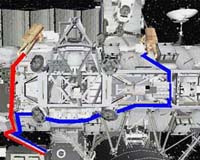
Houston (SPX) Jul 05, 2004 Flight controllers put Control Moment Gyro (CMG) 2 back into full operation Friday morning, two days after a spacewalk restored its power supply. The International Space Station now has three of the 600-pound gyroscopes controlling its attitude, or orientation in space. The two other operating CMGs handled Station attitude control after a circuit breaker in CMG 2's power supply failed April 21. On Thursday CMG 2 was spun up to its operational rate of 6,600 rpm as part of a series of tests. It was added to the attitude control mix at about 7:30 a.m. EDT Friday. On Friday the crew worked on post-spacewalk activities, maintenance and physical exercise after a late wakeup call and a light-duty day on Thursday. Station Commander Gennady Padalka and NASA ISS Science Officer Mike Fincke changed out a module containing a faulty circuit breaker Wednesday evening, successfully restoring power to CMG 2. CMG 2 was successfully spun up for about a minute, to about 30 rpm, to verify it was working properly before being spun down. That was done while Padalka and Fincke were still at the worksite, the S0 center segment of the Station's main truss. "Gennady and Mike, we have some great news for you," Capcom Rex Walheim told the crew from Mission Control Houston shortly before 8 p.m. The circuit had been closed and power restored. "The R&R was successful." "That's great," Fincke replied. "Congratulations to you guys on the ground -- you guys put in so many hours to make this spacewalk possible." "We've been preparing for this for a month and a half," Padalka told Mission Control Houston. "Congratulations." Mission Control Moscow added its congratulations for both spacewalkers. The repair was completed well ahead of schedule. The spacewalkers returned to the Pirs Docking Compartment the way they had come, using the Strela crane attached to Pirs as a pathway. They were well ahead of their timeline, and completed "get ahead" tasks -- including installation of flexible handrails and a contamination monitor on Pirs. They subsequently entered the airlock and closed the hatch, ending the spacewalk at 10:59 p.m. EDT. Total time of the spacewalk was 5 hours, 40 minutes. Padalka and Fincke floated into space from the airlock after the hatch opened at 5:19 p.m., beginning a second try to replace a Station circuit breaker. They wore the same Russian Orlan spacesuits they used during their June 24 spacewalk, cut short after about 14 minutes because of a balky handle that activates a switch in Fincke's suit. That caused an unexpected pressure drop in his main oxygen tank. Restoration of electricity to CMG 2 was the purpose of the spacewalk. The two gyroscopes that kept working adequately controlled the Station's attitude, but a third operating CMG provides backup capability. The fourth CMG failed two years ago, and will be replaced when Space Shuttle flights resume next year. The gyroscopes are situated in the Z1 Truss just above the Station's Unity Node. In their investigation of the June 24 spacewalk, managers found the balky handle was not fully seated into the closed position before the spacewalk started. Russian technicians concluded that it was an isolated event and gave the crew an OK to use the same suits for Wednesday's spacewalk. Spacewalk preparation procedures were updated to provide additional verification to ensure the handle was in the proper position. This spacewalk followed the same plan crewmembers had set out to follow last week. That was to have been the first time a spacewalk was done in Russian spacesuits to replace a U.S. component on the U.S. segment of the Station. When the crew was outside the Russian segment of the Station, at the beginning and end of the spacewalk, flight controllers at Mission Control Moscow spoke to Fincke and Padalka in Russian. Outside the U.S. segment of the Station, the team in Houston spoke to them in English. At the main truss, Padalka and Fincke replaced the Remote Power Controller Module (RPCM) that houses the faulty circuit breaker. That done, Fincke and Padalka returned to the Russian crane, and Russian ground controllers again took over primary support. Throughout the spacewalk (the second for Fincke and the fourth for Padalka, who did two previous spacewalks aboard the Mir Space Station in 1998), flight controllers in Houston and Moscow remained in constant contact with each other, virtually working side by side despite the physical distance between them. During previous spacewalks, a single control center, either in Russia or the United States, has been the lead for the spacewalk. This spacewalk plan initially called for use of American spacesuits and the U.S. Quest Airlock. But the crew could not get the cooling system of one of the U.S. spacesuits to work. Using the Russian spacesuits posed some additional challenges. The spacewalkers used VHF radio antennas on the Russian end of the Station, and there was concern that the truss structure could interfere at times with those radio signals. But communications worked well throughout the spacewalk. They also had to go about twice as far to get to the worksite as they would have if they had started from the U.S. airlock. That meant they had to be outside the Station longer and use the Russian Strela cargo crane, attached to the Pirs, to reduce their travel time. Also, the Russian spacesuit gloves are not as supple as those of the American suits. If communications had been blocked, Padalka and Fincke might not have been able to talk to the ground or to each other. Control teams developed a system of four simple hand signals and had identified a place near the worksite from which their radios' signals could reach the antennas. Mission Control also had a "pager signal" to alert the spacewalkers. Controllers could simply turn off the light at the end of Canadarm2, positioned to provide camera views of the repair work. Neither the pager nor the hand signals were needed. This was the 54th spacewalk for station assembly and maintenance. Community Email This Article Comment On This Article Related Links Station at NASA SpaceDaily Search SpaceDaily Subscribe To SpaceDaily Express Space Station News at Space-Travel.Com
 NASA Had No Choice But To Buy Soyuz Flights
 Washington DC (SPX) Jan 09, 2006
NASA's announcement last week that it will pay Roskosmos $43.6 million for a round-trip ride to the International Space Station this spring, and an equivalent figure for an as-yet-undetermined number of future flights to the station until 2012, represents the agency's acknowledgment that it had no alternative. |
|
|

| The content herein, unless otherwise known to be public domain, are Copyright 1995-2006 - SpaceDaily.AFP and UPI Wire Stories are copyright Agence France-Presse and United Press International. ESA PortalReports are copyright European Space Agency. All NASA sourced material is public domain. Additionalcopyrights may apply in whole or part to other bona fide parties. Advertising does not imply endorsement,agreement or approval of any opinions, statements or information provided by SpaceDaily on any Web page published or hosted by SpaceDaily. Privacy Statement |