|
 |
 |
 |
 |
 |
 |
 |
 |

 |
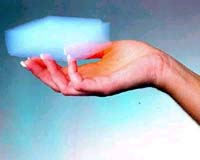
Guinness Records Names JPL's Aerogel World's Lightest Solid
Los Angeles - May 15, 2002 A new version of aerogel, the particle-collecting substance on NASA's Stardust spacecraft, has been recognized by Guinness World Records as the solid with the lowest density. Dr. Steven Jones of NASA's Jet Propulsion Laboratory, Pasadena, Calif., a materials scientist who created the aerogel used by Stardust, also created a lighter version that weighs only 3 milligrams per cubic centimeter (.00011 pounds per cubic inch.) The team received the official certificate yesterday. Guinness World Records approved the new aerogel's application for the least dense solid in March. Astronomer David Hawksett, Guinness World Records' science and technology judge, decided that Jones' aerogel beat out the previous record holder, an aerogel that weighed 5 milligrams per cubic centimeter (.00018 pounds per cubic inch.) Aerogel is pure silicon dioxide and sand, just as is glass, but aerogel is a thousand times less dense than glass because it is 99.8 percent air. It is prepared like gelatin by mixing a liquid silicon compound and a fast-evaporating liquid solvent, forming a gel that is then dried in an instrument similar to a pressure cooker. The mixture thickens, and then careful heating and depressurizing produce a glassy sponge of silicon. What remains is sometimes called "solid smoke," for its cloudy translucent color and super-light weight. Surprisingly, this seemingly brittle substance is durable and easily survives launch and space environments. "It's probably not possible to make aerogel any lighter than this because then it wouldn't gel," Jones said. "The molecules of silicon wouldn't connect. And it's not possible to make it lighter than the density of air, 1.2 milligrams per cubic centimeter (.00004 pounds per cubic inch), because aerogel is filled with air." To change the density, Jones simply changes the amount of silicon in the initial mixture. Stardust will use aerogel to capture particles from comet Wild 2 in 2004. NASA used aerogel for thermal insulation on the Mars Pathfinder mission. It will also be used on the 2003 Mars Exploration Rover, and may aid a proposed fundamental- physics testing mission and the Mars Scout Program. Community Email This Article Comment On This Article Related Links StarDust SpaceDaily Search SpaceDaily Subscribe To SpaceDaily Express Space Technology News - Applications and Research
 NGC Chosen To Proceed With Developing Solid-State Laser Technology For Military Applications
 Redondo Beach CA (SPX) Jan 09, 2006
Northrop Grumman Corporation has been selected to develop "military-grade," solid-state laser technology that is expected to pave the way for the U.S. military to incorporate high-energy laser systems across all services, including ships, manned and unmanned aircraft, and ground vehicles. |
|
|

| The content herein, unless otherwise known to be public domain, are Copyright 1995-2006 - SpaceDaily.AFP and UPI Wire Stories are copyright Agence France-Presse and United Press International. ESA PortalReports are copyright European Space Agency. All NASA sourced material is public domain. Additionalcopyrights may apply in whole or part to other bona fide parties. Advertising does not imply endorsement,agreement or approval of any opinions, statements or information provided by SpaceDaily on any Web page published or hosted by SpaceDaily. Privacy Statement |