|
 |
 |
 |
 |
 |
 |
 |
 |

 |
Guardian Commercial Airliner Anti-Missile System Achieves 6,000 Operational Hours Milestone
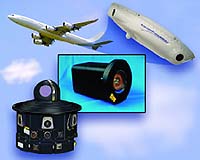
Rolling Meadows IL (SPX) Aug 29, 2007 Northrop Grumman has announced the achievement of more than 6,000 on-aircraft operational hours for the Guardian Counter-Man Portable Air Defense System (C-MANPADS) currently installed on seven wide-body cargo aircraft flying daily in commercial revenue service. "This milestone marks an important event for Northrop Grumman and the aviation industry. For the first time, we have been able to collect valuable logistics data while operating Guardian on aircraft in routine commercial service," said Jeff Palombo, vice president of Infrared Countermeasures at Northrop Grumman's Defensive Systems Division. "This data proves the Guardian system is a viable concept for commercial applications to protect aircraft from today's modern MANPADS threats." Under the terms of the operational test and evaluation portion of the U.S. Department of Homeland Security's (DHS) C-MANPADS program, which concludes in March 2008, a Northrop Grumman-led industry team has completed production of 12 Guardian missile defense systems with successful installation to date on seven MD-10 aircraft. The purpose of this evaluation phase is to collect reliability data in a standard, day-to-day operational environment and, as of July 31, the Guardian system has achieved a cumulative total of 5,163 on-aircraft operating hours during more than 1,150 revenue service flights. The Guardian system is a defensive aid utilizing proven military technology to defend against the commercial aviation threat posed by anti-aircraft, shoulder-fired missiles. Once launched, the missile is detected by the Guardian system, which then directs a non-visible, eye-safe laser to the seeker of the incoming missile, disrupting its guidance signals, and protecting the aircraft. To date, Northrop Grumman has completed an extensive flight test program in commercial test operational environments that included the use of a ground-based electronic missile surrogate to simulate the launch of a shoulder-fired missile toward aircraft during takeoff and landing. The tests were performed on an MD-11, an MD-10 and a B-747 aircraft. In each test, the Guardian system functioned as designed, automatically detecting the simulated launch and mock missile. The company's Guardian system makes use of multi-band laser and other technologies from the company's military directional infrared countermeasures system, the only such protection system currently in production for the U.S. military and several allied nations. Northrop Grumman's Guardian system was developed as part of the Department of Homeland Security's initiative aimed at protecting commercial aircraft from attack by ground-based, shoulder-fired missiles. The DHS program is focused on demonstrating the viability, economics and effectiveness of adapting existing military technology to protect commercial aircraft, both passenger and cargo, from this terrorist threat. Community Email This Article Comment On This Article Related Links The latest in Military Technology for the 21st century at SpaceWar.com
 BVR Systems Wins Air Defence Simulator Contract
 Rosh Ha'ayin, Israel (SPX) Aug 29, 2007
BVR Systems has announced a contract valued at $10.1 million for the provision of an Air Defence Simulator for an international customer. The Air Defence Simulator facility is re-configurable to support multiple weapon types and, as such, enables the training of Air Defence personnel in the operation of various Short Range Air Defence (SHORAD) weapons. Furthermore, the Simulator enables training of Air Defence Command and Control functions. |
|
|

| The content herein, unless otherwise known to be public domain, are Copyright 1995-2007 - SpaceDaily.AFP and UPI Wire Stories are copyright Agence France-Presse and United Press International. ESA Portal Reports are copyright European Space Agency. All NASA sourced material is public domain. Additional copyrights may apply in whole or part to other bona fide parties. Advertising does not imply endorsement,agreement or approval of any opinions, statements or information provided by SpaceDaily on any Web page published or hosted by SpaceDaily. Privacy Statement |