|
 |
 |
 |
 |
 |
 |
 |
 |

 |
Growing Sino-India Military Ties
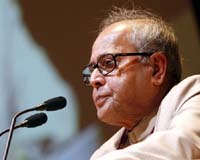
New Delhi (UPI) Jun 07, 2006 Indian defense minister Pranab Mukherjee's recent visit to Japan, China and Singapore indicates the emergence of a creative regional security strategy that boosts New Delhi's global image, Indian defense analysts said Tuesday. "Mukherjee's recent visit to three Asian countries, particularly China, has consolidated the new strategy by expanding the military ties with China and deepening security cooperation with Japan," said A.B. Mahapatra, the director of the Centre for Asian Studies, a New Delhi based think tank. Mahapatra said Mukherjee capped it all at the end of his visit in Singapore, where he unveiled a comprehensive defense strategy that was aimed at reinforcing India's traditional claim of a central security role on the Asian continent and Indian Ocean. In a landmark development, India and China inked a pact to expand military cooperation between two Asian giants during defense minister Mukherjee's recent three-nation tour. As part of the second leg of his visit, Mukherjee arrived in Beijing June 4 to sign a military accord, which the Indian defense establishment said would institutionalize training, exercises and other contacts between the two countries. "During the visit, India and China signed a memorandum of understanding on exchanges and cooperation in the field of defense," the Indian foreign office said in a statement. On the military pact, the Indian defense ministry said it was aimed at developing a strategic and cooperative partnership for peace and prosperity between India and China. During his Monday visit to Beijing, Mukherjee held discussions with his Chinese counterpart, Cao Gangchun, and foreign minister Li Zhaoxing. The Indian embassy in Beijing said the two sides held talks on wide ranging issues, including military and security cooperation. "My efforts will be to have a much larger participation in joint military exercises, more exchange visits by armed forces personnel and an expanded mutual training program," Mukherjee said. The Indian defense minister said the visit was an important milestone and a major confidence building measure in Sino-India relations. The defense agreement signed during the visit could become an instrument for a regular and sustained dialogue between the two sides on issues relating to defense. The relations between the two countries have never been as cordial as they are today. Diplomatic ties between the two were severed after they fought a small but bitter war in 1962, which ended in India's defeat. India took the initiative in the early 1990s to improve relations, but they have yet to resolve a long-standing boundary dispute. The India-China military pact assumes significance on the heels of reports that China has been providing military assistance to India's archrival Pakistan. The two principles at the core of the defense doctrine Mukherjee presented to China are India's determination to become a major power on the Asian continent and the designation of the Indian Ocean as a peace zone. Following remarkable improvement in its relations with the United States and other western countries, India has been working hard to raise its standing in matters of Asian security. Analysts say the Indian strategy to achieve this goal is to engage with all but align with none, and Mukherjee's three-nation visit was part of this strategy. During his China visit, Mukherjee was given an in-depth presentation of China's military modernization program by Gen Guo Boxiong, vice chairman of the central military commission of China. "We both reiterated that reform of the military should not be seen as a threat to each other," Mukherjee said after the presentation. In Japan, Mukherjee was apprised of Tokyo's concerns regarding China's military build-up. Japan also sought India's support in calling for greater transparency in Beijing's defense program for the sake of overall Asian stability. Mukherjee told the Japenese that China had been an important military power from the beginning. "We are fully aware of it, but every country has its own perception of the development and modernization of their armed forces," Mukherjee said. Chinese authorities welcomed the argument of Mukherjee, saying India has distanced itself from the Japanese viewpoint of Beijing's military build-up, which Tokyo says is posing a threat to the stability to the Asian continent.
Source: United Press International Community Email This Article Comment On This Article Related Links - Learn about the Superpowers of the 21st Century at SpaceWar.com Learn about nuclear weapons doctrine and defense at SpaceWar.com
 Senior US General Holds Talks With Top Brass Of India Military
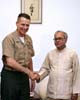 New Delhi (AFP) Jun 07, 2006
Washington's highest-ranking military official, General Peter Pace, Monday urged India to strengthen defence ties with the United States to help bring stability to troubled South Asia. Pace called for closer cooperation between the two countries' armed forces after talks with Defence Minister Pranab Mukherjee and heads of India's military. |
|
|

| The content herein, unless otherwise known to be public domain, are Copyright 1995-2006 - SpaceDaily.AFP and UPI Wire Stories are copyright Agence France-Presse and United Press International. ESA PortalReports are copyright European Space Agency. All NASA sourced material is public domain. Additionalcopyrights may apply in whole or part to other bona fide parties. Advertising does not imply endorsement,agreement or approval of any opinions, statements or information provided by SpaceDaily on any Web page published or hosted by SpaceDaily. Privacy Statement |