|
 |
 |
 |
 |
 |
 |
 |
 |

 |
Growing Pains: T. Rex Was Teenage Giant
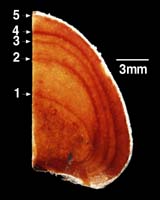
Tallahassee FL (SPX) Aug 12, 2004 Most teenagers have growing pains, but none probably compared to those of Tyrannosaurus rex as it ascended to adulthood more than 65 million years ago, according to a Florida State University researcher. From around age 14 to 18, T. rex took on about 70 percent of its adult mass, growing from a 1-ton carnivorous lizard to a bone-crushing, 6-ton dinosaur eating machine with few rivals in the prehistoric kingdom, according to FSU biologist Gregory Erickson. At the peak of this spurt, T. rex grew more than 4.5 pounds a day. Erickson and his team of paleontologists are the first to establish an accurate picture of how T. rex accelerated its growth over a relatively few years to become gargantuan while earlier, smaller relatives had much slower growth. The scientists did this by counting growth rings in the bones of T. rex and other members of its family and calculating the corresponding body size by measuring the circumference of the femur. The research is featured as the cover story for the Aug. 12 edition of the journal Nature. T. rex's growth rate is comparable to that of the modern day elephant. But while elephants have a lifespan of more than 70 years, T. rex lived no more than 30 years. "We now know that T. rex lived fast and died young," said Erickson. Erickson and Peter Makovicky, dinosaur curator at The Field Museum and a coauthor of the study, will join with other team members at the Chicago museum on Wednesday to announce their findings. The museum is home to Sue� [The Field Museum], the world's largest, oldest and most complete T. rex fossil, which was discovered in South Dakota in 1990. Erickson has spent much of his career exploring how some dinosaurs got so big. The first dinosaurs to roam the Earth some 225 million years ago were about a yard long and weighed between 50 to 100 pounds, he said. The giants, such a T. rex and A. sarcophagus, came along about 150 million years later. "Almost every child asks: 'How did dinosaurs get so big?' That has remained one of the great mysteries in paleontology," Erickson said. "Here we cracked the code for one family of dinosaurs, the Tyrannosauridae." Like trees, dinosaur bones are marked by growth rings, with a new one developing every year. But there was one giant obstacle to counting the rings: Most of the big, meat-eating dinosaurs' bones remodeled themselves as they grew and become hollow, erasing much of the growth record. A possible solution to this dilemma came to Erickson about four years ago while examining Sue. He noticed that Sue's rib bones were solid. Further investigation revealed that the fibula (a leg bone) and some hipbones were also solid and retained the full compliment of growth rings. Erickson assembled a team of researchers from the American Museum of Natural History, The Field Museum, Canada's Royal Tyrrell Museum of Palaeontology, Stanford University and the University of Iowa. They examined cross sections of bones from 20 Tyrannosaurs that ranged from 2 to 28 years of age and establish T. rex's accelerated growth rate during its teenage years. The researchers verified their results by comparing the dinosaurs' growth rings to those of modern-day alligators and lizards, whose rings are similar. Ten years ago such research may have been impossible, Erickson said. Museums wouldn't have allowed scientists to cut away at T. rex bones to examine growth rings because there were only a few good specimens. But a flurry of discoveries in the past decade - there are now more than 30 known T. rex specimens worldwide - have given museums a greater comfort level and allowed more invasive scientific research. Community Email This Article Comment On This Article Related Links Florida State University SpaceDaily Search SpaceDaily Subscribe To SpaceDaily Express Dirt, rocks and all the stuff we stand on firmly
 Magnetic Reconnection Region Larger Than 2.5 Million Km Found In The Solar Wind
 Paris (ESA) Jan 12, 2006
Using the ESA Cluster spacecraft and the NASA Wind and ACE satellites, a team of American and European scientists have discovered the largest jets of particles created between the Earth and the Sun by magnetic reconnection. This result makes the cover of this week's issue of Nature. |
|
|

| The content herein, unless otherwise known to be public domain, are Copyright 1995-2006 - SpaceDaily.AFP and UPI Wire Stories are copyright Agence France-Presse and United Press International. ESA PortalReports are copyright European Space Agency. All NASA sourced material is public domain. Additionalcopyrights may apply in whole or part to other bona fide parties. Advertising does not imply endorsement,agreement or approval of any opinions, statements or information provided by SpaceDaily on any Web page published or hosted by SpaceDaily. Privacy Statement |