|
 |
 |
 |
 |
 |
 |
 |
 |

 |
Groundhog Day
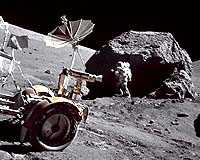
Scottsdale - Dec 19, 2002 Today marks the thirtieth anniversary of the end of the Apollo program when Apollo 17 returned to Earth in a flawless splash down in the Pacific Ocean. It is also the day we abandoned the universe beyond low Earth orbit and to commemorate the event I propose that we move that quintessential American holiday forward a couple months and declare December 19 - Groundhog Day. As in the Bill Murray movie of the same name, our space efforts have been stuck in a loop, endlessly repeating the same events over and over until maybe, finally, we learn something and free ourselves to move on. Thirty years should be enough repetition of tax-financed circling in LEO: let's draw some conclusions and get on with building a spacefaring civilization. In the movie, Murray played a cynical drone of a TV weatherman, someone who'd chosen to ignore his own talents in order to cultivate a superficial appeal, to his audiences and to the people in his personal life. The repetition of one Groundhog Day forced him to develop skills and values enabling him to be of service to his community, to develop a popularity built on real utility and deep connection. NASA and the global space community, after a generation of Groundhog Days, are just beginning to learn the lessons that enabled Murray to break the cycle and move on. Some of those lessons are beginning to generate real change, the kind of change necessary to put an end to thirty years of more-of-the-same in space and launch us into an era of progress and transformation. What We're Doing Doesn't Work: If our goal is to build a permanent, sustainable human presence in space, we have to begin by acknowledging failure. We're not there; we don't have the "2001: A Space Odyssey" future. The observation is obvious, but much of the space community has failed to draw the logical conclusion: the methods we've been using to achieve our goals have failed. We've stuck ourselves with repetitive behaviors, and so we keep reliving Groundhog day. Dependence on governments and the aerospace giants who service them has failed. A space-enthusiast effort focused on government-agency boosterism has failed. Entrepreneurial efforts ungrounded in incrementalism and ruthless financial realism have failed. "Space is cool" educational programs have failed. Success will require not just new approaches but an end to wasting efforts on the old ones. You can't dig your way out of a hole. We're Only Fooling Ourselves: All of us in the space community have been like Murray's smarmy weatherman, pulling ever-more outrageous stunts, making increasingly grandiose claims, to grab the attention of fickle audiences. Nobody bought Murray's act, and nobody's buying ours. The primary work product of NASA and Big Aerospace is "viewgraph engineering:" ferociously expensive studies that generate beautiful artwork of cool spaceships - and nothing else. Nobody other than newcomers believes any of the stuff will ever be built. The cynicism behind such efforts, verging on corruption where public funds are involved, is corrosive to the credibility of the entire space enterprise. The same holds true with much of the outreach focused on schoolchildren: that captive audience has a fine nose for adult speciousness, and they're not buying outer-space gee-whiz: they can see the level of interest and attention paid to space by their parents and the media, and can see for themselves that the humans-in-space effort in particular is ghastly dull. To be sure, our messages to our children are more a product of wishful thinking than the intentional design of space Potemkin villages perpetrated on taxpayers, but the disconnect between reality and the empty flash of presentations is equally discrediting. Bureaucracies Aren't Bold: Another lesson that should be obvious, this one has escaped government space supporters and critics alike. Governmental efforts can't afford to fail, but they can afford not to succeed. "We're still working on it" prevents blame and ensures a continued supply of funding to manage what must be an oh-so intractable problem. "We thought we had it, but it blew up" leads to messy investigations. This simple rule of human behavior has several consequences for space. One is that very old technology will stay in service long past its intended life: better the devil you know. Another is that simultaneously, research and development will focus on the most distant, blue-sky, projects, ones that can safely be studied for generations without incurring the wrath of legislators expecting results. Ignored if possible and stamped out if necessary are the incremental advances and completely new products that are the staple of commercial efforts. Some of this is driven by the procurement process, which ensures that product development must meet current, not envisioned, needs, and must incur great documentation expense up front. Some of it is the inevitable product of the bureaucratic mindset, which in all times and cultures values stability and self-preservation over innovation and progress. Bureaucracies excel at repetition, at established and routine procedures - at being stuck in Groundhog Day. We Need to be Useful: Arguably, Apollo generated real utility for the American culture of its time. Soviet space efforts had severely threatened America's self-perception as a technologically advanced, can-do society. That image had to be redeemed, and through a grand gesture. Otherwise, the "space program" has provided little to meet the real needs of the community, be that America or the world. There have been quiet triumphs: the general ability of remote sensing data has made a real contribution to safety and prosperity. Certainly communications satellites have been an immense boon.

|