|
 |
 |
 |
 |
 |
 |
 |
 |

 |
Groundbreaking Signals Start Of NASA Constellation Flight Tests
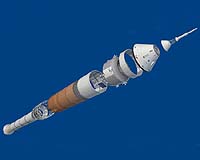
Las Cruces NM (SPX) Nov 15, 2007 With less than a year until flight tests of NASA's Constellation Program, work is under way on a launch pad that will host the first of those tests. Workers broke ground on a pad where the agency will test a launch abort system for the new Orion spacecraft at the U.S. Army's White Sands Missile Range near Las Cruces, N.M. Orion's launch abort system will carry astronauts to safety in the event of a problem on the launch pad or during the spacecraft's climb to orbit. The first of five tests of the system, known as Pad Abort 1 or PA-1, is scheduled for fall 2008. Data from the series will help engineers refine the design of the launch abort system. "Flight tests are where the rubber meets the road. These tests will help validate our designs or correct any flaws," said Skip Hatfield, Orion Project Manager at NASA's Johnson Space Center, Houston. "The goal here is simple: to provide our astronauts a route to safety should anything go wrong at a launch." The first launch abort test will include a mock-up of the Orion capsule on the pad. An abort motor will fire for two seconds, sending the boilerplate crew module to an altitude of one mile. Three 116-foot diameter parachutes will deploy to slow the mock crew capsule for landing. Constellation is developing the Orion spacecraft to send astronauts to the International Space Station and to the moon. Orion will be launched atop an Ares I rocket. The program is also developing a heavy-lift rocket, Ares V, to enable cargo missions to the moon. NASA plans to set up a lunar outpost by 2020, where astronauts will prepare for possible future missions to Mars and other destinations in the solar system. Community Email This Article Comment On This Article Related Links Space Exploration at NASA Rocket Science News at Space-Travel.Com
 SpaceX Completes Development Of Merlin Regeneratively Cooled Rocket Engine
 Hawthorne CA (SPX) Nov 13, 2007
Space Exploration Technologies Corp. reports it has completed development of its Merlin 1C next generation liquid fueled rocket booster engine. It is among the highest performing gas generator cycle kerosene engines ever built, exceeding the Boeing Delta II main engine, the Lockheed Atlas II main engine, and on par with the Saturn V F-1 engine. |
|
|

| The content herein, unless otherwise known to be public domain, are Copyright 1995-2007 - SpaceDaily.AFP and UPI Wire Stories are copyright Agence France-Presse and United Press International. ESA Portal Reports are copyright European Space Agency. All NASA sourced material is public domain. Additional copyrights may apply in whole or part to other bona fide parties. Advertising does not imply endorsement,agreement or approval of any opinions, statements or information provided by SpaceDaily on any Web page published or hosted by SpaceDaily. Privacy Statement |