|
 |
 |
 |
 |
 |
 |
 |
 |

 |
Ground-Based Telescopes Have An Extremely Large Future
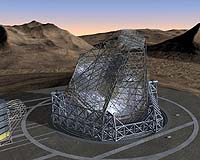
London, UK (SPX) Apr 11, 2005 The largest ground-based optical telescopes in use today use mirrors that are 10 m (33 ft) across. But the prospects for future Extremely Large Telescopes (ELTs) are looking up. According to recent studies by international teams of astronomers and leading astronomical organisations, the next generation of optical telescopes could be 50-100 metres (165 - 330 ft) in diameter - big enough to fill a sports stadium. This "quantum leap" in size has important implications, since astronomers want to capture every photon of light that comes their way, and a 100m mirror has a collecting area up to 100 times greater than existing instruments. Furthermore, a 100m telescope would have extremely sharp vision, with the ability to see objects at up to 40 times the spatial resolution of the Hubble Space Telescope. On Friday 8 April, Dr. Isobel Hook of Oxford University told the RAS National Astronomy Meeting in Birmingham about the compelling scientific case for Extremely Large Telescopes which has been developed at a series of meetings over the past four years. The results of this evaluation process, which involved more than 100 astronomers, have recently been published, coinciding with the start of the European Extremely Large Telescope Design Study. "A team of over 100 European Astronomers has recently produced a brochure summarising the science that could be done" said Dr. Hook. "This work is the result of a series of meetings held in Europe over the last 4 years, sponsored by the EC network OPTICON. "The new report explains how an ELT will revolutionise all aspects of astronomy, from studies of our own solar system - by producing images of comparable detail to those from space probes - to the edge of the observable Universe." As the report states: "The vast improvement in sensitivity and precision allowed by the next step in technological capabilities, from today's 6-10m telescopes to the new generation of 50-100 m telescopes with integrated adaptive optics capability, will be the largest such enhancement in the history of telescopic astronomy. It is likely that the major scientific impact of these new telescopes will be discoveries we cannot predict, so that their scientific legacy will also vastly exceed even that rich return which we can predict today." Astronomers believe that with an ELT it will not only be possible to find planets orbiting other stars, but also to identify and study habitable Earth-like planets by identifying the presence of liquid water, oxygen and methane. Many of the mysteries about the high-energy Universe will also be answered. An ELT would be able to provide key insights into the nature of black holes, galaxy formation, the mysterious "dark matter" pervading the Universe and the even more mysterious "dark energy" that is pushing the Universe apart. An ELT will also be sensitive enough to detect the first galaxies that were born only a few hundred million years after the Big Bang, as well as very early supernova explosions, whose light has travelled for over 10 billion years to reach us. "Some of the most exciting discoveries cannot be predicted now," said Dr. Hook. "New astronomical instruments have always surprised us with the unexpected." An ELT would make such advances possible for two main reasons - the large collecting area enables it to detect the faintest sources, and the telescope's huge diameter allows extremely sharp images (provided the effects of atmospheric turbulence are corrected by adaptive optics). Would it be possible to build such a telescope? "Initial studies are very positive, suggesting that a 50-100 m segmented telescope could be built within 10-15 years for a cost of around 1 billion Euros," said Dr. Hook. A major design study is now starting in Europe, aimed at developing the technology needed to build Extremely Large Telescopes. The study has been awarded 8 million Euros from the EC Framework Programme 6 plus additional funds from the participants (the European Southern Observatory, together with universities, institutes and industry around Europe, including the UK). Community Email This Article Comment On This Article Related Links RAS National Astronomy Meeting Website SpaceDaily Search SpaceDaily Subscribe To SpaceDaily Express Space Telescope News and Technology at Skynightly.com
 Carl Zeiss And Max Planck Researchers Develop Optical Technology For JWST
 Heidelberg, Germany (SPX) Dec 09, 2005
Carl Zeiss Optronics, in Oberkochen, Germany, and the Max Planck Institute for Astronomy in Heidelberg (MPIA), are developing the main fine mechanical optical technology for two instruments to be part of the James Webb Space Telescope (JWST).
--------------------------------------------------------- It's new. And it's downright terrific! Celestron's CPC Schmidt-Cassegrain telescope is the scope you've been waiting for! It offers new alignment technology, advanced engineering, and bold new design at a new, low price! In fact, Celestron's Professional Computerized (CPC) scope with revolutionary SkyAlign Alignment Technology redefines everything that amateur astronomers are looking for. It offers quick and simple alignment, GPS technology, unsurpassed optical quality, ease of use, advanced ergonomics, enhanced computerization and, most important, affordability. Want to view M-31 tonight? One button takes you there!
Shop for telescopes online at Telescopes.com! today!
|
|
|

| The content herein, unless otherwise known to be public domain, are Copyright 1995-2006 - SpaceDaily.AFP and UPI Wire Stories are copyright Agence France-Presse and United Press International. ESA PortalReports are copyright European Space Agency. All NASA sourced material is public domain. Additionalcopyrights may apply in whole or part to other bona fide parties. Advertising does not imply endorsement,agreement or approval of any opinions, statements or information provided by SpaceDaily on any Web page published or hosted by SpaceDaily. Privacy Statement |