|
 |
 |
 |
 |
 |
 |
 |
 |

 |
Griffin Vows To Send Shuttle Mission To Hubble
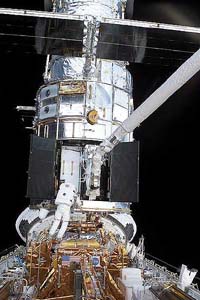
Washington DC (SPX) Jan 10, 2006 NASA administrator Michael Griffin repeated a pledge Tuesday he has made several times since taking over the space agency last April. Speaking to a packed house at the 207 th meeting of the American Astronomical Society, Griffin said because of his deep appreciation of the scientific importance of the Hubble Space Telescope, "NASA will, if at all possible, use one of the remaining flights of the space shuttle for Hubble servicing." The fate of the aging Hubble has remained in doubt since February 1, 2003, when the shuttle Columbia disintegrated in the skies above Texas during re-entry, killing all seven of its crew members. After that tragedy, NASA administrator Sean O'Keefe said he would only consider a robotic spacecraft to repair the Hubble because he could not assure the safety of shuttle astronauts sent on such a mission. Griffin, who told the audience he has pursued a career in space ever since he was a small boy in the 1950s, said NASA needs to conduct at least one more test flight of the shuttle to evaluate its safety. Even then, there may be no guarantees of a safe and completed mission, "but I am hopeful," he said. He estimated that NASA's continuing efforts to mount a shuttle mission to repair and refit the Hubble � which currently is down to two working gyroscopes � are running about $10 million per month, or $120 million a year. He said the agency is looking at attempting the mission by the end of 2007, so the total cost � not including the cost of any new hardware � would be something under $200 million. Despite his own previous involvement in studying a robotic repair mission, he said the possibility is virtually non-existent. "Within the timeframe available," Griffin said, "there is no robotic mission which is basically going to do anything other than a controlled de-orbit. If time and money were not an issue, I totally believe that the robotic repair could work. But time and money are issues, and in the context of the available money I judged it to be unfeasible. I am sorry to tell you it is either a shuttle mission to repair Hubble or it will not be repaired." Griffin's talk ranged from topics such as supporting a reinvigoration of the NASA Advisory Council as a participant in the agency's science policy decisions � he said he thought the council's role had been "marginalized" under the agency's previous leadership � to presenting a posthumous award to John Bahcall, a former NASA astronomer and AAS president who was instrumental in developing the Hubble program. He also said he recognized "there has been significant concern within the scientific community" about whether the costs of the Bush administration's Vision for Space Exploration � which was announced by the president in January 2004 � will alter NASA's level of support for space astronomy. "It is not our desire to sacrifice present-day scientific efforts for the sake of future benefits to be derived from exploration," Griffin said. "We who run NASA today are doing our very best to preserve a robust science program in the face of some daunting fiscal realities that affect all domestic discretionary spending. These realities dictate that we set priorities." He bluntly told the AAS audience, however, that "NASA simply cannot accomplish everything that was on our plate when I took office last April. In space-based astronomy, as in other areas, we will have to make tough choices between maintaining current missions, of which there are 14, and developing new capabilities. It is a difficult time." Griffin also said that because of the renewed push to return U.S. astronauts to the Moon, it might be time to reconsider the possibility of using Earth's only natural satellite as a future platform for new observatories, particularly for radio astronomy. "To my way of thinking," he said, "a stable platform like the Moon offers advantages in the engineering aspects of astronomy that are hard to obtain in space. The back side of the Moon offers a region which is substantially quieter from a radio astronomy perspective than any other region I can conveniently think of." He quickly added he did not want the scientific community to think he was promoting "another space station, meaning I will not say 'hey, we're doing this for you and here are all the great things that can occur.' I well recognize that no one would go to the Moon to site astronomical platforms, but if we're going there anyway for other and larger purposes, then science can benefit by rethinking some of the engineering traits that are involved in the choice of basing modes." When considering whether or not to have a research station on the Moon in some future decade, he explained, "the opportunities that that would offer and the costs it would have should be rethought and should not simply be taken as having been decided decades ago." Community Email This Article Comment On This Article Related Links SpaceDaily Search SpaceDaily Subscribe To SpaceDaily Express Space Shuttle News at Space-Travel.Com
 NASA's Soyuz Deal Will Not Scrap Shuttle
 Washington DC (SPX) Jan 11 2006
NASA's announcement last week that it will pay Roskosmos $43.8 million to transport one astronaut to and another one from the International Space Station this year represents the agency's acknowledgment that it has no immediate alternative if it wishes to continue its presence and participation in the orbiting facility.
--------------------------------------------------------- It's new. And it's downright terrific! Celestron's CPC Schmidt-Cassegrain telescope is the scope you've been waiting for! It offers new alignment technology, advanced engineering, and bold new design at a new, low price! In fact, Celestron's Professional Computerized (CPC) scope with revolutionary SkyAlign Alignment Technology redefines everything that amateur astronomers are looking for. It offers quick and simple alignment, GPS technology, unsurpassed optical quality, ease of use, advanced ergonomics, enhanced computerization and, most important, affordability. Want to view M-31 tonight? One button takes you there!
Shop for telescopes online at Telescopes.com! today!
|
|
|

| The content herein, unless otherwise known to be public domain, are Copyright 1995-2006 - SpaceDaily.AFP and UPI Wire Stories are copyright Agence France-Presse and United Press International. ESA PortalReports are copyright European Space Agency. All NASA sourced material is public domain. Additionalcopyrights may apply in whole or part to other bona fide parties. Advertising does not imply endorsement,agreement or approval of any opinions, statements or information provided by SpaceDaily on any Web page published or hosted by SpaceDaily. Privacy Statement |