
 |
 |
 |
 |
 |
 |
 |
 |
 |

 |
Greenland glaciers still disintegrating
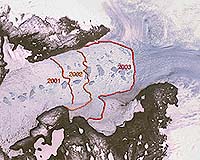
Columbus, Ohio (UPI) Aug 21, 2008 U.S. scientists monitoring Greenland's glaciers say they expect two of the largest glaciers to disintegrate within the next year. Ohio State University Associate Professor Jason Box of the school's Byrd Polar Research Center says a massive 11-square-mile piece of the Petermann Glacier in northern Greenland broke away last month. Box and graduate students Russell Benson and David Decker say they're even more concerned about what appears to be a massive crack farther back from Petermann's margin. They said that crack, seen in satellite images, might signal an imminent and much larger breakup. "If the Petermann glacier breaks up back to the upstream rift, the loss would be as much as 60 square miles," said Box. That would represent a loss of one-third of the massive ice field. At the same time, the scientists say the margin of the immense Jakobshavn glacier has retreated farther inland than it has during 150 years of observation. The researchers believe the glacier hasn't retreated to where it is now in at least the last 4,000 to 6,000 years. The scientists are using data from National Aeronautics and Space Administration satellites and from cameras that monitor global warming effects on Greenland's glaciers. Community Email This Article Comment On This Article Share This Article With Planet Earth
Related Links Beyond the Ice Age
 Dynamic Past Ice Age May Help Prepare Society For Future Changes
 Boulder CO (SPX) Aug 19, 2008
This new Special Paper from the Geological Society of America brings together a wealth of recent work to understand the longest icehouse period in Phanerozoic Earth history, the late Paleozoic ice age. |
|
|

| The content herein, unless otherwise known to be public domain, are Copyright 1995-2007 - SpaceDaily.AFP and UPI Wire Stories are copyright Agence France-Presse and United Press International. ESA Portal Reports are copyright European Space Agency. All NASA sourced material is public domain. Additional copyrights may apply in whole or part to other bona fide parties. Advertising does not imply endorsement,agreement or approval of any opinions, statements or information provided by SpaceDaily on any Web page published or hosted by SpaceDaily. Privacy Statement |
 del.icio.us
 Digg
Digg Reddit
 YahooMyWeb
 Google
 Facebook