|
 |
 |
 |
 |
 |
 |
 |
 |

 |
Greenland Ice Core Project Yields Probable Ancient Plant Remains
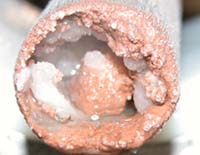
Greenland (SPX) Aug 16, 2004 A team of international researchers working on the North Greenland Ice Core Project recently recovered what appear to be plant remnants nearly two miles below the surface between the bottom of the glacial ice and the bedrock. Researchers from the project, known as NGRIP, said particles found in clumps of reddish material recovered from the frozen, muddy ice in late July look like pine needles, bark or blades of grass. Thought to date to several million years ago before the last ice age during the Pleistocene epoch smothered Greenland, the material will be analyzed in several laboratories, said researchers. The suspected plant material under about 10,400 feet of ice indicates the Greenland Ice Sheet "formed very fast," said NGRIP project leader Dorthe Dahl-Jensen, a professor at the University of Copenhagen's Niels Bohr Institute. "There is a big possibility that this material is several million years old - from a time when trees covered Greenland," she said. "Several of the pieces look very much like blades of grass or pine needles," said University of Colorado at Boulder geological sciences Professor James White, a NGRIP principal investigator. "If confirmed, this will be the first organic material ever recovered from a deep ice-core drilling project," said White, also a fellow of CU-Boulder's Institute of Arctic and Alpine Research. The ice cores in which the reddish material was found also contain a high content of trapped gas, which is expected to help researchers determine what the area's climate history was like on an annual basis during the past 123,000 years. Each yearly record of ice can reveal past temperatures and precipitation levels, the content of ancient atmospheres and even evidence for the timing, direction and magnitude of distant storms, fires and volcanic eruptions, said White. NGRIP is an international project with participants from Denmark, Germany, Japan, the United States, Switzerland, France, Sweden, Belgium and Iceland. NGRIP is funded by the participating countries, including the U.S. National Science Foundation. The cores from NGRIP are cylinders of ice four inches in diameter that were brought to the surface in 11.5-foot lengths. Developed by the NGRIP research team, the specialized deep ice drill has been used to bore several deep ice cores. The NGRIP drilling site is located roughly in the middle of Greenland at an elevation of about 9,850 feet. The temperature in the subsurface trenches where ice-core scientists worked is minus 22 degrees Fahrenheit. CU-Boulder doctoral student Trevor Popp of INSTAAR was the lead driller on the 2004 NGRIP effort. Another CU-Boulder graduate student, Annalisa Schilla, also participated in the 2004 NGRIP field season. Community Email This Article Comment On This Article Related Links NGRIP Niels Bohr Institute SpaceDaily Search SpaceDaily Subscribe To SpaceDaily Express Nuclear Space Technology at Space-Travel.com
 Rewriting Glacial History In Pacific North America
 Edmonton AB (SPX) Jan 10, 2006
Although the story on glacier fluctuations in northwestern North America over the last 10,000 years has remained largely unchanged for decades, new evidence discovered by a University of Alberta researcher will rewrite that glacial history and offer clues about our climate history during the last several thousand years. |
|
|

| The content herein, unless otherwise known to be public domain, are Copyright 1995-2006 - SpaceDaily.AFP and UPI Wire Stories are copyright Agence France-Presse and United Press International. ESA PortalReports are copyright European Space Agency. All NASA sourced material is public domain. Additionalcopyrights may apply in whole or part to other bona fide parties. Advertising does not imply endorsement,agreement or approval of any opinions, statements or information provided by SpaceDaily on any Web page published or hosted by SpaceDaily. Privacy Statement |