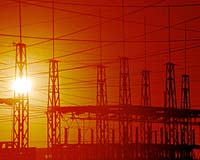
File image of the California power grid.
File image of the California power grid. |
Renewable resources such as wind, solar and geothermal are often located in remote areas removed from the wholesale transmission grid. These "location-constrained generating resources" will help California meet its Renewable Portfolio Standard, yet their development is often hampered by a lack of adequate transmission capacity. It can be difficult to find financing for transmission projects to reach generation that has not been built yet hence the chicken or egg dilemma. Which should come first, generation or the transmission capacity needed to get the power to the grid?
Under the process approved today, the appropriate Participating Transmission Owner (PTO) would build the "trunk lines" out to the renewable-rich areas, initially recovering its costs through the FERC-approved Transmission Revenue Requirement (TRR). As individual generation projects are built and connected to the grid, each generator would pay its pro-rata share of the annual TRR payments. This financing arrangement would continue until the entire capacity of the project is subscribed at which time the remaining revenue requirement for the end-state transmission facility is completely supported by the project developers.
Currently, new power plant owners are responsible for the upfront cost of building transmission trunk lines to the grid and the costs can be prohibitive for smaller renewable power developers.
"This plan removes a major obstacle blocking the development of renewable resources," said ISO President and CEO Yakout Mansour. "This new hybrid financing method is a creative way to help alternative energy suppliers connect to the grid. It is all a part of leveling the playing field for green power generators and guaranteeing their non-discriminatory grid access. They still pay their fair share, but the costs are spread and appropriately based on when the green power comes on line."
"This is exactly the type of creative solution California is known for," said ISO Board of Governor's Chair Mason Willrich. "FERC approval of this plan will give California a way to add the infrastructure we need to get more green power to the grid. Our tariff proposal is already receiving national attention and may very well be replicated in other areas."
Early this year, the California ISO asked FERC for a Declaratory Order, seeking FERC's approval-in-concept and additional guidance regarding this issue. In April 2007, FERC granted the Declaratory Order and called for the California ISO to conduct an extensive stakeholder process to gain their input. The results of that process are incorporated into the plan the ISO Board approved today and in the final tariff language that will be filed with FERC by the end of this month.
The California ISO is a not-for-profit public benefit corporation charged with managing the flow of electricity along California's open-market wholesale power grid. The mission of the California ISO is to safeguard the reliable delivery of electricity, and ensure equal access to 25,000 circuit miles of "electron highway." As the impartial operator of the wholesale power grid in the state, the California ISO conducts a small portion of the bulk power markets. These markets are used to allocate space on the transmission lines, maintain operating reserves and match supply with demand in real time.
Community
 Ohio Ready to Take World Stage in Wind Energy Development
 Columbus OH (SPX) Oct 19, 2007
| The content herein, unless otherwise known to be public domain, are Copyright 1995-2007 - SpaceDaily.AFP and UPI Wire Stories are copyright Agence France-Presse and United Press International. ESA Portal Reports are copyright European Space Agency. All NASA sourced material is public domain. Additional copyrights may apply in whole or part to other bona fide parties. Advertising does not imply endorsement,agreement or approval of any opinions, statements or information provided by SpaceDaily on any Web page published or hosted by SpaceDaily. Privacy Statement |