|
 |
 |
 |
 |
 |
 |
 |
 |

 |
Gravity Probe B mission Status Report
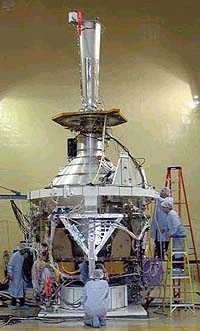
Stanford CA (SPX) Jul 21, 2004 Nearly three months in orbit, Gravity Probe B, a NASA experiment to test two predictions of Albert Einstein, continues to perform well. All four gyroscopes-the ultra-precise spheres that will be used to test Einstein's general theory of relativity-are ready for full-speed spin-up. Nearing the end of its in-orbit and calibration phase, Gravity Probe B is managed by the Marshall Center. At just under three months in orbit, Gravity Probe B is nearing the end of the Initialization and Orbit Checkout (IOC) phase of the mission. The spacecraft remains in excellent health, and all subsystems are continuing to perform well. All four gyros are digitally suspended, with gyros #2 and #4 spinning at science mission speed-greater than 80Hz (4,800 rpm)-and gyros #1 and #3 spinning at approximately 1.5 Hz (90 rpm), ready for full-speed spin-up. The updated drag-free thruster control software that was uploaded to the spacecraft three weeks ago to optimize performance of the Attitude and Translation Control system (ATC) is continuing to perform nominally. The spacecraft's roll rate is 0.52 rpm, and the science telescope is being re-locked onto the guide star, IM Pegasi, following the full-speed spin-up of gyro #2 yesterday. Each full-speed spin-up takes most of a day. Helium gas is flowed over the gyro for 90 seconds, and tests are run to ensure that the helium usage rate for that gyro corresponds to previous measurements. If all measurements check out, the full-speed spin-up, in which helium gas is flowed over the rotors for 2-3 hours, commences. The GP-B operations team controls the spin-up process by sending commands from the Mission Operations Center (MOC) at Stanford to the spacecraft. Real-time telemetry provides immediate feedback on the progress of the spin-up so that various parameters can be adjusted as necessary. Community Email This Article Comment On This Article Related Links Gravity Probe B at Stanford Gravity Probe B SpaceDaily Search SpaceDaily Subscribe To SpaceDaily Express Space Technology News - Applications and Research
 Industry Team Achieve New Communications Technology With AESA Radars
 Baltimore MD (SPX) Jan 12, 2006
A team comprised of three leading US aerospace and defense contractors has demonstrated an innovative technological use of active electronically scanned array (AESA) radars for high-bandwidth communications. |
|
|

| The content herein, unless otherwise known to be public domain, are Copyright 1995-2006 - SpaceDaily.AFP and UPI Wire Stories are copyright Agence France-Presse and United Press International. ESA PortalReports are copyright European Space Agency. All NASA sourced material is public domain. Additionalcopyrights may apply in whole or part to other bona fide parties. Advertising does not imply endorsement,agreement or approval of any opinions, statements or information provided by SpaceDaily on any Web page published or hosted by SpaceDaily. Privacy Statement |