|
 |
 |
 |
 |
 |
 |
 |
 |

 |
Gravitational Lens Reveals Heart Of A Distant Galaxy
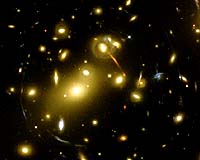
Boston - Feb 11, 2004 Many examples are known where a galaxy acts as a gravitational lens, producing multiple images on the sky of a more distant object like a bright quasar hidden behind it. But there has been a persistent mystery for over 20 years: Einstein's general theory of relativity predicts there should be an odd number of images, yet almost all observed lenses have only 2 or 4 known images. EMBARGOED until 1:00 p.m. EST, Wednesday, February 11, 2004 Now, astronomer Joshua Winn of the Harvard-Smithsonian Center for Astrophysics (CfA) and two former CfA colleagues, David Rusin (now at the University of Pennsylvania) and Christopher Kochanek (The Ohio State University), have identified a third, central image of a lensed quasar. Radio observations of the system known as PMN J1632-0033 in the constellation Ophiuchus uncovered a faint central image, which can be used to investigate the properties of the lensing galaxy and the supermassive black hole expected to lie at its center. "Finding this central image is interesting in its own right, but is even more important for what it can tell us about the lensing galaxy. This offers us a new tool for studying galaxies so far away that, even to the Hubble Space Telescope, they're just faint smudges," said Winn. Quasars are extremely distant and bright objects believed to be powered by supermassive black holes. They shine brightly by converting the gravitational energy of matter falling into the black hole into light and other types of radiation, such as radio waves. In gravitational lensing, light rays from a quasar which pass close to a galaxy are bent by the galaxy's gravitational field, much as they would be bent when passing through a glass lens. The denser the center of a galaxy, and the stronger its gravity, the fainter the central image will be. Yet this central image, whose light has passed closest to the middle of the lensing galaxy, can tell us much about that galaxy's core. That opportunity makes finding such central images particularly desirable. In the system PMN J1632-0033, a radio-loud quasar at redshift z=3.42 (a distance of about 11.5 billion light-years) is being lensed by an elliptical galaxy at redshift z~1 (about 8 billion light-years away). Two images of the quasar were known to exist, and a third, very faint radio source was suspected to be the central image. However, that third source was right on top of the lensing galaxy, and so might have been intrinsic to the lensing galaxy itself. By observing the radio "color," or spectrum, of all three images using the National Science Foundation's Very Large Array and Very Long Baseline Array, Winn and his colleagues provided compelling evidence that the third source is indeed the quasar's central image. Its spectrum is essentially identical to the other two images, except at low frequencies where some of the radio energy was absorbed by the lensing galaxy. The geometry and properties of the quasar's three images already are telling us about the core of the lensing galaxy. For example, its central black hole weighs less than 200 million solar masses. Also, its surface density (amount of matter as projected against the plane of the sky) at the location of the central image is more than 20,000 solar masses per square parsec. (For comparison, the surface density of the Milky Way near our sun is about 50 solar masses per square parsec.) Both figures for the lensing galaxy agree with expectations based on detailed observations of galaxies hundreds of times closer to the Earth. "Almost all of our knowledge about galaxy centers comes from studying very nearby galaxies. The remarkable thing about central images is that you can get similar information about the cores of galaxies hundreds of times farther away, and billions of years younger than our neighboring galaxies," said Winn. Community Email This Article Comment On This Article Related Links Harvard-Smithsonian Center for Astrophysics SpaceDaily Search SpaceDaily Subscribe To SpaceDaily Express Nuclear Space Technology at Space-Travel.com
 Carina Nebula Dust Pillars Harbor Embedded Stars
 Boulder CO (SPX) May 31, 2005
Astronomers using NASA's Spitzer Space Telescope have imaged a giant molecular cloud being shredded by howling stellar winds and searing radiation, exposing a group of towering dust pillars harboring infant stars, according to a University of Colorado at Boulder researcher. |
|
|

| The content herein, unless otherwise known to be public domain, are Copyright 1995-2006 - SpaceDaily.AFP and UPI Wire Stories are copyright Agence France-Presse and United Press International. ESA PortalReports are copyright European Space Agency. All NASA sourced material is public domain. Additionalcopyrights may apply in whole or part to other bona fide parties. Advertising does not imply endorsement,agreement or approval of any opinions, statements or information provided by SpaceDaily on any Web page published or hosted by SpaceDaily. Privacy Statement |