|
 |
 |
 |
 |
 |
 |
 |
 |

 |
Grant Awarded To Study Interaction Of Ecology And Evolution
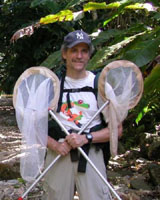
Riverside CA (SPX) Oct 10, 2006 An interdisciplinary team of researchers led by David Reznick, an evolutionary biologist at UC Riverside, has been awarded $5 million over five years by the National Science Foundation (NSF) to conduct an experimental study on how ecology - a branch of science concerned with the interrelationship of an organism and its environment - and evolution interact. The findings of the study are expected to help explain how environmental changes influence an organism's evolution as well as how the evolving organism, in turn, changes the ecosystem in which it is embedded. Reznick, a professor of biology and the principal investigator of the grant from NSF's Frontiers in Integrative Biological Research (FIBR) program, in collaboration with colleagues specializing in molecular biology, population ecology, ecosystems science, biogeochemistry and applied mathematics, will perform the study of evolution/ecology interactions in natural stream communities on the island of Trinidad. Specifically, the team will focus on guppies - small fresh-water fish biologists have studied for long - that coexist in the stream with Hart's killifish, a predator. The team will examine not only what causes the guppies to evolve as they might but also the co-evolution of the killifish. "We know the fish are evolving, but the ecosystem they find themselves in is also changing," Reznick said. "It is popularly thought that evolution is so much slower than ecology that the two can be thought of as independent, but our results for guppies and those for other organisms show that evolution can be so fast that it happens on time scales that are similar to ecological interactions. If this is true, then changes in the ecosystem, such as the availability of resources or how many predators there are or the cycling of essential nutrients, can exert new evolutionary pressures on the guppies at the same time that the evolution of guppies causes changes to the ecosystem. Questions about how organisms - including humans - evolve or why communities have certain properties may not be answered correctly without considering such 'eco-evolutionary' feedback loops." In their research, Reznick and colleagues will contrast populations of guppies that live in low-predation sites (guppies and Hart's killifish) with those that live in high-predation sites (guppies, Hart's killifish and other predators). Low- and high-predation sites exist in the same stream in Trinidad. They are separated by natural, barrier waterfalls that exclude predators but not guppies and Hart's killifish. Previous research by Reznick has shown that guppies in low predation sites are found at higher population densities than in high predation sites. They have lower levels of food availability, which causes them to have lower growth rates and a smaller body size. Reznick found, too, that guppies living in environments with a large number of predators have adapted to reproduce earlier in life than guppies from low-predation localities. "These differences occur because guppy populations expand in the absence of predators," he said. "The converse is that guppy population density is lower and food availability is higher in the presence of predators. In our experiments, we will add guppies in sections of the stream that had none before to see if ecological interactions are independent of evolution and if these interactions impact all aspects of the ecosystem. The research team chose Trinidad as the research site because of prior history of work done on guppies on the island and the simplified nature of island communities. Reznick, who specializes in the study of adaptation, has more than 25 years of experience working with guppies in Trinidad. The researchers plan to genetically tag each guppy and follow its progress over time, including not only its growth and survival, but also its reproductive success, which can be detected through genetic markers. They also will quantify the expansion and evolution of the guppies; the associated changes in Hart's killifish and other organisms in the community; and the changes in nutrient availability. Reznick and his colleagues will use these results to develop mathematical models to evaluate the feedback between the evolution of guppies and Hart's killifish and the remainder of the ecosystem. NSF's FIBR program supports integrative research that addresses major questions in the biological sciences. It encourages investigators to identify major understudied or unanswered questions in biology and to use innovative approaches to address them by integrating the scientific concepts and research tools from across disciplines, including biology, mathematics and the physical sciences, engineering, social sciences and the information sciences. "FIBR provides the support necessary to allow scientists to tackle the most challenging questions in biology," said Alan Tessier, FIBR program officer. "This award is exemplary in meeting the FIBR goals. It is a highly collaborative and multi-institutional project that promises to experimentally and conceptually link ecosystem ecology with coevolutionary processes in natural systems." Community Email This Article Comment On This Article Related Links University of California - Riverside Darwin Today At TerraDaily.com Darwin Today At TerraDaily.com
 Study Pinpoints Tropics As Biodiversity Spawning Ground
 Chicago IL (SPX) Oct 09, 2006
A team of scientists has completed a study that explains why the tropics are so much richer in biodiversity than higher latitudes. And they say that their work highlights the importance of preserving those species against extinction. |
|
|

| The content herein, unless otherwise known to be public domain, are Copyright 1995-2006 - SpaceDaily.AFP and UPI Wire Stories are copyright Agence France-Presse and United Press International. ESA PortalReports are copyright European Space Agency. All NASA sourced material is public domain. Additionalcopyrights may apply in whole or part to other bona fide parties. Advertising does not imply endorsement,agreement or approval of any opinions, statements or information provided by SpaceDaily on any Web page published or hosted by SpaceDaily. Privacy Statement |