|
 |
 |
 |
 |
 |
 |
 |
 |

 |
Granicus Valles And Tinjar Valles
Darmstadt, Germany (SPX) Aug 04, 2006 This image, taken by the High Resolution Stereo Camera aboard ESA's Mars Express spacecraft, shows regions of Granicus Valles and Tinjar Valles that might have been formed partly through the action of subsurface water, due to a process known as sapping. The HRSC obtained the image during orbit 1,383 at a ground resolution of approximately 23.7 meters (77 feet) per pixel. The image has been rotated 90 degrees counter-clockwise, so North is to the left. It shows the regions of Granicus and Tinjar Valles, lying at approximately 26.8 degrees north latitude and 135.7 degrees east longitude. The northwest-aligned valles are part of the Utopia-Planitia region, an area thought to be covered by a layer of lava that flowed from the northwest flanks of Elysium Mons into the Utopia-Planitia Basin. Today, this once-smooth volcanic plain is incised by channels of variable size and appearance, including Granicus Valles (toward the West, or bottom of the image) and Tinjar Valles (toward the North, or left side). Both channel systems evolve from a single main channel entering the image scene from southeast (upper right), exhibiting an approximate width of 3 kilometers (2 miles) and extending 300 meters (1,000 feet) below the surrounding terrain at maximum. The impressive sinuous lava channel emanates from the mouth of a radial, a circular drainage area and runs to the Elysium rise trending into a graben, which is terrain dissected by tectonic deformation. Planetary scientists interpret the narrow, straight, 4-kilometer (2.5-mile) wide and 120-kilometer (75-mile) long graben as the source of both lava flows and debris flows that carved Granicus and Tinjar Valles. Similar Elysium flank grabens at higher elevations lack outflow channels. This elevation dependence leads scientists to suggest that subsurface water, released by volcanic activity, later played a role in shaping the channels visible today. Image resolution has been decreased for use on the Internet. Community Email This Article Comment On This Article Related Links Mars Express The Art of Space - Desktops and Eyecandy
 Hubble Sees Cosmic Fireworks Display E0102 In The Small Magellanic Cloud
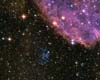 Baltimore MD (SPX) Aug 04, 2006
Reminiscent of a U.S. Independence Day celebration, here is a NASA Hubble Space Telescope image of a cosmic explosion that is quite similar to fireworks on Earth. In the nearby Small Magellanic Cloud, a massive star has exploded as a supernova, and begun to dissipate its interior into a spectacular display of colorful filaments. |
|
|

| The content herein, unless otherwise known to be public domain, are Copyright 1995-2006 - SpaceDaily.AFP and UPI Wire Stories are copyright Agence France-Presse and United Press International. ESA PortalReports are copyright European Space Agency. All NASA sourced material is public domain. Additionalcopyrights may apply in whole or part to other bona fide parties. Advertising does not imply endorsement,agreement or approval of any opinions, statements or information provided by SpaceDaily on any Web page published or hosted by SpaceDaily. Privacy Statement |