|
 |
 |
 |
 |
 |
 |
 |
 |

 |
Government space budgets to continue growth
Paris - Dec 11, 2003 The growth in government spending on space may surpass US$50 billion by 2010, up from today's US$43 billion, according to Euroconsult's newly released report World Prospects for Government Space Markets: 2004 Edition. Prospects for the space industry are good, with strong growth to be driven by the increase in the military space spending, especially in the US. The overall picture masks regional differences however.
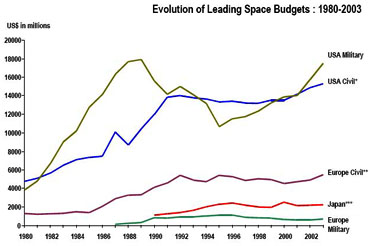 US civil spending on the rise The current rising trend of the US civil space budget should be confirmed in the years to come: NASA expects its budget to reach almost US$17 billion in 2008 (excluding the non-space elements), up from US$14 billion today. This figure could reach US$18 billion by 2010. Even if the Columbia disaster causes a spending peak in the short term, its long-term effects are less clear and could put into question the agency's budget planning. Towards a European space budget recovery? On the other side of the Atlantic, the current depressed space market could be boosted by strong government support. The European Commission's White Paper foresees a recovery of European budgets with two growth scenarios consistent with Europe's objectives for space (annual growth of 4.6% in the optimistic scenario and of 3.4% in the conservative scenario). Europe's 2003 consolidated budget of US$6.2 billion could grow to between US$7.8 billion (conservative scenario) and US$8.5 billion (optimistic) in 2010. The European Union is already involved in the Galileo and Global Monitoring for Environment & Security (GMES) projects, and the European Security & Defense Policy could well provide a framework for increased military space spending. Asia: the most dynamic market To achieve the region's considerable goals, budgets in Asia are expected to continue their dramatic growth. India's budget more than quadrupled in local currency terms between 1992 and 2003 (tripled in dollar terms to US$500 million), representing unparalleled growth. India and China's space programs are the most dynamic with ambitious moon missions planned. Smaller countries such as Taiwan and South Korea plan to significantly expand their space missions as well. Japan has radically restructured its space organization hoping to boost space funding and increase efficiency. Emerging space programs: new market opportunities More countries are considering the use of space systems for their social, economic, environmental and security needs. About 30 emerging space programs are active over the world offering a third market for the industry alongside commercial and domestic government markets. They provide a means for agencies and industry to promote and export their technology, expertise and services. Annual budgets vary from a few to tens of millions of dollars, but the adoption of a significant program could create substantial opportunities, as has been seen in Taiwan or Malaysia. Mixing private and public funding to boost the market Private capital is playing a greater role in funding government ventures where public institutions have little room for maneuver. It provides governments the financial flexibility to establish programs of a scale unachievable with public funds alone. Seven space projects have already been started under a public-private partnership (PPPs), six of which are in Europe. The Galileo project, the largest PPP to date with a cost of �3.2 billion (excluding operation costs), was formally launched in 2003 with the start of the development phase and the creation of the Galileo Joint Undertaking (GJU) to manage the concession awarding process up to 2005. Added to this, governments are increasingly seeking to use commercial capacity to supply their communication and Earth observation needs. Community Email This Article Comment On This Article Related Links Euroconsult SpaceDaily Search SpaceDaily Subscribe To SpaceDaily Express The latest information about the Commercial Satellite Industry
 Stratos Steps Closer To Xantic Acquisition
 Bethesda MD (SPX) Jan 5, 2006
Stratos Global recently announced it had taken a step closer toward the completion of the acquisition of Xantic, having received positive advice from the Works' Council in the Netherlands, and executed a definitive agreement to purchase Xantic from KPN and Telstra Corporation. |
|
|

| The content herein, unless otherwise known to be public domain, are Copyright 1995-2006 - SpaceDaily.AFP and UPI Wire Stories are copyright Agence France-Presse and United Press International. ESA PortalReports are copyright European Space Agency. All NASA sourced material is public domain. Additionalcopyrights may apply in whole or part to other bona fide parties. Advertising does not imply endorsement,agreement or approval of any opinions, statements or information provided by SpaceDaily on any Web page published or hosted by SpaceDaily. Privacy Statement |