|
 |
 |
 |
 |
 |
 |
 |
 |

 |
Good News From Big Bad Black Holes
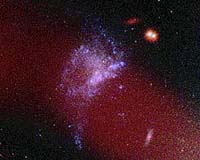
Livermore CA (SPX) Jan 11, 2005 Astronomers have discovered how ominous black holes can create life in the form of new stars, proving that jet-induced star formation may have played an important role in the formation of galaxies in the early universe. Using the Very Large Array (VLA) at the National Radio Astronomy Observatory in New Mexico, the Keck telescopes in Hawaii and the Hubble Space Telescope, astronomers Wil van Breugel and Steve Croft have shown that "Minkowski's Object," a peculiar starburst system in the NGC 541 radio galaxy, formed when a radio jet � undetectable in visible light but revealed by radio observations� emitted from a black hole collided with dense gas. The researchers carried out the observations after computer simulations at Lawrence Livermore National Laboratory by Chris Fragile, Peter Anninos and Stephen Murray had shown that jets may trigger the collapse of interstellar clouds and induce star formation. The astronomers will present their findings today at the American Astronomical Society 205th national meeting, in San Diego, Calif. "Some 20 years ago this kind of thinking was thought to be science fiction," said van Breugel, who along with Croft works at the Laboratory's Institute for Geophysics and Planetary Physics. "It brings poetic justice to black holes because we think of them as sucking things in, but we've shown that when a jet emits from a black hole, it can bring new life by collapsing clouds and creating new stars." Radio jets are formed when material falls into massive black holes. Magnetic fields around the black holes accelerate electrons to almost the speed of light. These electrons are then propelled out in narrow jets and radiate at radio frequencies because of their motion in the magnetic fields. The jets may affect the formation of stars when they collide with dense gas. But only recently have van Breugel and Croft figured out how this happens. The regions between stars in a galaxy are filled with mainly gas and dust, and are commonly called the interstellar medium. The gas appears primarily in two forms as cold clouds of atomic or molecular hydrogen or as hot ionized hydrogen near young stars. In the case of the recent discovery, the Livermore researchers observed that when a radio jet ran into a hot dense hydrogen medium in NGC 541, the medium started to cool down and formed a large neutral hydrogen cloud and, in turn, triggered star formation. Although the cloud did not emit visible radiation, it was detected by its radio frequency emission. "The formation of massive black holes is critical to the formation of new galaxies," Croft said. Van Breugel, who has been studying black holes since his days as a postdoctoral fellow more than 20 years ago, said the recent observations are another good reason to study the relationship between black holes and early galaxies. He said the conditions his team saw in NGC 541 may be important in understanding the formation of galaxies in the early universe. "Our observations show that jets from black holes can trigger extra star formation. In the early universe this process may be important because the galaxies are still young, with lots of hydrogen gas but few stars, and the black holes are more active," he said. According to the big bang theory, the universe is believed to have originated approximately 13.5 billion years ago from a cosmic explosion that hurled matter in all directions. Although van Breugel and Croft observed the jets by using the VLA, Keck and Hubbel images, they also said that the Livermore computer simulations by Fragile, Anninos and Murray were crucial to verify that this is happening. NGC 541 is approximately 216 million light years from Earth and is roughly half the size of the Milky Way. In addition to van Breugel and Croft, other collaborators on the project include W. de Vries, UC Davis; J. H. van Gorkom, Columbia University; R. Morganti and T. Osterloo, ASTRON, Netherlands; M. Dopita, Australian National University; C. Fragile, UC Santa Barbara; and Anninos and Murray, LLNL. Community Email This Article Comment On This Article Related Links National Radio Astronomy Observatory Keck telescopes Hubble Space Telescope SpaceDaily Search SpaceDaily Subscribe To SpaceDaily Express Black Hole Science and News
 MIT: SpInning Black Hole Leaves Dent In Space-Time
 Boston MA (SPX) Jan 12, 2006
MIT scientists and colleagues have found a black hole that has chiseled a remarkably stable indentation in the fabric of space and time, like a dimple in one's favorite spot on the sofa. |
|
|

| The content herein, unless otherwise known to be public domain, are Copyright 1995-2006 - SpaceDaily.AFP and UPI Wire Stories are copyright Agence France-Presse and United Press International. ESA PortalReports are copyright European Space Agency. All NASA sourced material is public domain. Additionalcopyrights may apply in whole or part to other bona fide parties. Advertising does not imply endorsement,agreement or approval of any opinions, statements or information provided by SpaceDaily on any Web page published or hosted by SpaceDaily. Privacy Statement |