|
 |
 |
 |
 |
 |
 |
 |
 |

 |
Goddard Contracts For Rapid GLAST Studies
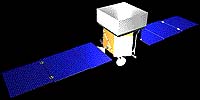
Los Angeles - May 25, 2000 - TRW and Lockheed Martin have been awarded three-month independent study contracts by NASA's Goddard Space Flight Center to determine how best to accommodate the science payload for NASA's Gamma Ray Large Area Space Telescope (GLAST) using a spacecraft from Goddard's Rapid II Catalog of spacecraft. GLAST is the follow-on mission to the TRW-built Compton Gamma Ray Observatory (CGRO) mission. Scheduled for launch in 2005, GLAST will explore the most energetic and violent events in the universe. Its 3,000-kilogram science payload, which comprises the GLAST Large Area Telescope Flight Investigation and the Gamma-Ray Burst Monitor, will study stellar phenomena such as gamma ray bursts, neutron stars, supernova remnants and distant galaxies fueled by super massive black holes at their centers. GLAST's primary instrument is expected to be about 30 times more sensitive to gamma ray sources than the Energetic Gamma Ray Experiment Telescope (EGRET) used aboard CGRO. "We're extremely proud as a company to have been selected to prepare designs for this very important mission," said Dr. Domenick Tenerelli, Lockheed Martin's program manager for GLAST. "A mission that seeks to understand the most energetic events in the cosmos is particularly exciting. We're delighted to be able to work with NASA Goddard on this fundamental mission to better understand the structure and evolution of the universe," added Tenerelli. The Lockheed Martin Space Systems design will incorporate the LM 900 bus, used on the IKONOS commercial remote sensing spacecraft built for Space Imaging EOSAT of Thornton, CO. The LM 900 is ideal for meeting the data, power distribution, and stability requirements for GLAST. "This contract builds on the solid foundation of experience that TRW acquired as the system prime contractor and spacecraft producer for NASA's highly successful Compton Gamma Ray Observatory mission," said Fred Ricker, vice president and general manager, TRW Space & Laser Programs Division. "We're looking forward to continuing the strong partnership that enabled CGRO to be one of the most scientifically productive missions of the 1990s." Under terms of the new contract, TRW will determine the most cost- effective way to meet the GLAST mission requirements based on TRW's existing, qualified spacecraft products in NASA's Rapid II catalog. NASA's Rapid II spacecraft catalog is a procurement practice designed to enable rapid development and production of spacecraft using standardized spacecraft products. Following the initial GLAST study and some more detailed studies in the near future, NASA will select a contractor to build the GLAST spacecraft and integrate the payload with the spacecraft. NASA's current plan calls for the selection of a GLAST system prime contractor in 2002. Using the most powerful particle accelerators in the universe as cosmic laboratories, GLAST will explore the extreme environments of supermassive black holes, neutron stars, and gamma-ray bursts. On cosmological scales, GLAST will explore the era of star formation in the universe, the physics of dark matter and the creation and evolution of galaxies. GLAST is designed to operate in the energy range from 20 MeV to 300 GeV. It will provide a factor of better than 30 times the sensitivity of the Energetic Gamma Ray Experiment Telescope (EGRET) onboard the Compton Gamma Ray Observatory (CGRO). GLAST will observe at least ten times as many active galactic nuclei and stellar-mass black holes as previously detected in the gamma-ray band. It will study pulsars and supernova remnants, gamma-ray bursts, the diffuse Galactic and extragalactic high-energy gamma-ray backgrounds, and solar flares. Since its source location accuracy will be more than an order of magnitude better than that of EGRET, it will be able to associate unidentified EGRET sources with known celestial objects. GLAST will also search for annihilation-line radiation from weakly interacting massive particles, known as WIMPs, which may account for the dark matter. The mission's scientific objectives require a high-energy gamma-ray telescope with angular resolution sufficient to identify point sources with objects at other wavelengths, a wide field-of-view that will permit the study of sources that exhibit extreme intensity variations on timescales from seconds to months or longer, and a large effective area to detect a large sample of sources and determine their energy spectra. New detector technologies that offer significant improvements over existing hardware (a factor of between 10 and 100 improvement in source sensitivity, depending on energy) will allow these requirements to be met well within the cost constraints of an intermediate class astrophysics mission. Goddard Space Flight Center, Greenbelt, MD, will manage the GLAST mission for NASA's Office of Space Science in Washington, DC.
Email This Article Comment On This Article Related Links Space
 Satellite Launch To Boost DTH In India
 Calcutta, India (SPX) Dec 28, 2005
The successful launch Thursday of India's heaviest satellite from spaceport of Kourou in French Guyana may have boosted the country's space research efforts to yet another level, but it has also lifted the spirits of at least three Direct-To-Home televisions broadcasters, one of which has been waiting for years to launch its services in India.
--------------------------------------------------------- It's new. And it's downright terrific! Celestron's CPC Schmidt-Cassegrain telescope is the scope you've been waiting for! It offers new alignment technology, advanced engineering, and bold new design at a new, low price! In fact, Celestron's Professional Computerized (CPC) scope with revolutionary SkyAlign Alignment Technology redefines everything that amateur astronomers are looking for. It offers quick and simple alignment, GPS technology, unsurpassed optical quality, ease of use, advanced ergonomics, enhanced computerization and, most important, affordability. Want to view M-31 tonight? One button takes you there!
Shop for telescopes online at Telescopes.com! today!
|
|
|

|
|
|
|
|
|
|
|
|
|
|
|
| The content herein, unless otherwise known to be public domain, are Copyright 1995-2006 - SpaceDaily.AFP and UPI Wire Stories are copyright Agence France-Presse and United Press International. ESA PortalReports are copyright European Space Agency. All NASA sourced material is public domain. Additionalcopyrights may apply in whole or part to other bona fide parties. Advertising does not imply endorsement,agreement or approval of any opinions, statements or information provided by SpaceDaily on any Web page published or hosted by SpaceDaily. Privacy Statement |