|
 |
 |
 |
 |
 |
 |
 |
 |

 |
Glorious Space Cremation Ends Shenzhou-2 Extended Mission
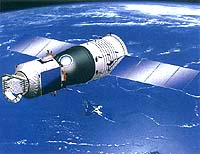
Beijing - August 25, 2001 After spending 260 days in space and successfully completing its mission, the Shenzhou-2 Orbital Module made a firey exit from orbit on Aug. 24. The Orbital Information Group (OIG) at NASA's Goddard Space Flight Center reported that SZ-2 OM reentered into the atmosphere on orbit number 3460 at about 0905 UTC (5:05 p.m. Beijing Time), with the reentry point near 33.1 deg S in latitude and 260.4 deg E in longitude - giving a reentry location over the eastern Pacific Ocean between Easter Island and Chile. There was no immediate report on whether any part of SZ-2 OM survived the reentry. Owing to the remote location of the reentry area, it is unlikely that surviving debris, if any, would be seen or detected. The second unmanned test flight of the domestically-built Shenzhou spacecraft lifted off from the Jiuquan Satellite Launch Centre (JSLC), China's manned spaceflight centre, in the northwestern Gansu Province in the early morning hours of Jan. 10 this year. A Changzheng-2F (Long March-2F) rocket, which also made its second flight, delivered SZ-2 into orbit. By coincidence the launch made SZ-2 the first spacecraft to achieve orbit in the new millennium. Unlike the maiden flight which the world only learned about it after the mission ended, Chinese media widely reported the SZ-2 mission soon after the launch. Space officials even released a status report midway through the mission, a practice that had rarely occured in the Chinese space program. The primary objective of the mission was to test the environment control and life protection systems, and 13 other subsystems of the spacecraft using flight-rated equipment. In addition to the engineering tests the space vehicle, which consisted of a Propulsion Module, a Descent Module and an Orbital Module, carried a collection of experiments on space life sciences and biological technology research, space materials, space astronomy, and space environment monitoring. This was China's first integrated multidisciplinary space science mission. Some biological specimens, such as fruit flies, were live passengers as part of the space life science experiments. Scientists are interested in learning the effects of microgravity on the specimens. The material science experiments involved making and observing the growth of various kinds of crystals and semiconductors. SZ-2 also carried 20,000 seeds of a variety of plants and vegetables. The seeds were simply left exposed to space radiation. Chinese scientists claim that seeds which have been exposed to cosmic radiation yield superior quality produce. All experiment samples in the life and material sciences studies as well as the seeds returned to Earth in the Descent Module six days later. The module landed in Inner Mongolia in the bitterly cold evening of Jan. 16. The primary mission of SZ-2 ended without fanfare. There was no immediate post-flight information or photos of the landing. Scientists immediately began examining the returned experiments. Half a year after the Descent Module landing, in mid-July scientists announced scientific and technological breakthroughs in several experiments that were flown on SZ-2. Meanwhile the Orbital Module continued to circle the Earth. On-board sensors examined the orbital environment to obtain key information such as its composition, particle densities and radiation characteristics. Also installed on the Orbital Module were three high-energy radiation detectors that astronomers used to study energetic cosmic events, for example, the mysterious gamma-ray bursts and solar eruptions. During the primary and the extended missions, flight controllers had commanded the spacecraft to carry out orbital maneuvers to maintain its attitude and orbital altitude. The multiple on-orbit adjustments and the successful completion of the extended mission is a demonstration that China is capable of maintaining an orbiting platform for a prolonged period. Such a capability is an important step towards China's eventual goal of establishing its own permanent manned presence in space. With the SZ-2 mission ends formally, attention is turned to the next unmanned test flight SZ-3. Wen Wei Po, a pro-Beijing newspaper in Hong Kong, reported on July 23 that the SZ-3 launch preparation entered "an intense period" and hinted that the launch was imminent. However, on July 26 the Yangtse Evening Post in Nanjing quoted an unidentified "senior official from the relevant department" as saying that there was no plan to launch SZ-3 in the near future. Four days later Wen Wei Po reported that three of the four Yuanwang (YW, Yuanwang means "Long View") tracking vessels spent the past two months at their home port in Shanghai to undergo refurbishment and upgrade in preparation of supporting the SZ-3 mission. The article showed a photo of YW-1 leaving port to test all systems after the upgrade. Although there is much confusion and speculation on whether the launch of SZ-3 is near, China is taking a cautious approach to systematically test all components of its manned space program thoroughly to ensure a high level of safety and reliability. Before long when the manned spaceflight technologies mature, China would make history and send its own yuhangyuans ("astronauts") into space in its divine spaceship. Community Email This Article Comment On This Article Related Links SpaceDaily Search SpaceDaily Subscribe To SpaceDaily Express The Chinese Space Program - News, Policy and Technology China News from SinoDaily.com
 Taikonauts On Moon A Far Off Dream For China Yet
 Beijing (XNA) Jan 05, 2006
A one-year lunar fly-by mission may start in April 2007 in China, but a manned flight to the Earth's neighbour may be a long way away, a chief lunar exploration scientist said last night. |
|
|

|
|
|
|
|
|
|
|
|
|
|
|
| The content herein, unless otherwise known to be public domain, are Copyright 1995-2006 - SpaceDaily.AFP and UPI Wire Stories are copyright Agence France-Presse and United Press International. ESA PortalReports are copyright European Space Agency. All NASA sourced material is public domain. Additionalcopyrights may apply in whole or part to other bona fide parties. Advertising does not imply endorsement,agreement or approval of any opinions, statements or information provided by SpaceDaily on any Web page published or hosted by SpaceDaily. Privacy Statement |