|
 |
 |
 |
 |
 |
 |
 |
 |

 |
Globalstar Gets Another Four Satellites Into Space
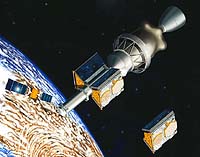
Milpitas CA (SPX) May 31, 2007 Globalstar and Starsem have reported the successful launch of four Globalstar satellites from the Baikonur Cosmodrome in Kazakhstan, using the Soyuz launch vehicle. These satellites, together with the additional four ground spare satellites due to be launched shortly, will augment the current operating constellation and improve the Globalstar quality of two-way voice and data service through the launch of the second-generation satellite constellation. The Globalstar satellites were launched from the Baikonur Cosmodrome in Kazakhstan on Wednesday, 30 May at 2:31 am local time (20:31 UTC and 1:31 pm May 29 in California), using the Soyuz-Fregat version of the Soyuz launch vehicle. This is the 1721st successful launch of the Soyuz family rocket. Starsem confirmed that the upper stage accurately injected the four-satellite dispenser into the targeted low earth orbit of 920 km at 4:18 am local time (22:18 UTC and 3:18 pm May 29 in California). Globalstar reports that all four satellites have been successfully acquired following separation of the Fregat Upper Stage and release from the satellite dispenser. While Globalstar is continuing to perform initial satellite in-orbit tests, the performance of all four spacecraft is nominal at this time. "We are absolutely ecstatic about this success and pleased to make this announcement," said Jay Monroe, Chairman and CEO of Globalstar, Inc. "We applaud all of our Globalstar employees world-wide who have worked tirelessly to make this day a reality. We also thank our proven launch provider Starsem as well as the prime contractor for the first generation satellites, Space Systems Loral, and sub-contractor Thales Alenia Space for this launch success." Mr. Monroe added, "Today is also a great day for Globalstar stockholders. Globalstar has invested approximately $120 million into the core satellite business in order to launch these four satellites plus the remaining four ground spares. Globalstar considers these eight satellites to represent the beginning of our next-generation constellation, because they will not only help bridge the gap today, but last long into and seamlessly operate with, our second-generation constellation." In December 2006, Globalstar signed a EURO 661 million (approximately $865 million) contract with Thales Alenia Space for the design, manufacture and delivery of 48 new satellites for the second-generation Globalstar satellite constellation, with deliveries scheduled to begin in the summer of 2009. The satellites are being designed to provide service until at least 2025. Mr. Jean-Yves Le Gall, President and CEO of Starsem expressed his satisfaction. "I would like to extend my congratulations to Mr. Jay Monroe, Chairman and CEO of Globalstar, and to thank Mr. Monroe for the confidence he has shown in Starsem and the Soyuz launcher. The work of Starsem and our Russian partners though is not yet finished and we look forward to our next successful launch for Globalstar later this summer." Thales Alenia Space is completing the necessary tests on the remaining four first-generation satellites at its facility in Rome, Italy. These satellites will then be shipped to the launch complex in Baikonur for final pre-launch preparations. Email This Article
Related Links  Reston VA (SPX) May 28, 2007
ICO Global Communications has signed a Launch Services and Dual Launch Study Agreement with ILS International Launch Services (ILS). With this contract, ICO has established a Proton launch services agreement for up to five launches in the 2009 through 2011 timeframe. In addition, ILS will design and propose a dual launch capability for ICO's Medium Earth Orbit (MEO) satellites. |
|
|

| The content herein, unless otherwise known to be public domain, are Copyright 1995-2006 - SpaceDaily.AFP and UPI Wire Stories are copyright Agence France-Presse and United Press International. ESA PortalReports are copyright European Space Agency. All NASA sourced material is public domain. Additionalcopyrights may apply in whole or part to other bona fide parties. Advertising does not imply endorsement,agreement or approval of any opinions, statements or information provided by SpaceDaily on any Web page published or hosted by SpaceDaily. Privacy Statement |