|
 |
 |
 |
 |
 |
 |
 |
 |

 |
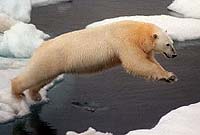
Global Warming Pushes Polar Bears To Cannibalism
Chicago (AFP) Jun 16, 2006 Polar bears are resorting to cannibalism as global warming shrinks the arctic ice cap and makes foraging for food more difficult, a recent study has found. "It really took us by surprise," lead researcher Steven Armstrup of the US Geological Survey said in a telephone interview from his Anchorage, Alaska office. "These are animals that actively stalked, hunted and killed and ate one of their own kind." While bears will kill and then eat other bears in fights over territory or females it is extremely rare for them to hunt other bears as prey, Armstrup said. In nearly 40 years of studying polar bears in northern Alaska and Canada, researchers had never observed such behavior. Until the winter of 2004 when three carcasses were discovered. The area where the bear remains were found - the Beaufort sea near the border between Alaska and Canada - has seen large retreats of polar ice in recent years. Bears in the region were "noticeably" thin because they had been forced to spend the summers either on ice over deep water, where there were fewer seals to hunt, or else on land, where foraging opportunities were poor. The first carcass found was of a mother bear stalked by a larger male who knocked down her den made of snow, attacked her and dragged her body away to be eaten. Two cubs inside the den were suffocated by the caved-in snow. The den was so far from traditional sea hunting grounds that researchers believe the male bear "was specifically searching for occupied dens." Her body was discovered in January, only hours after she was killed, by researchers using an infrared-equipped helicopter to study maternity dens. The body of another mother bear was discovered on the sea ice in April, along with tracks showing that her cub escaped. A few days later, researchers spotted an adult male feeding on a young bear it had stalked in its bed on the ice. While it is possible that cannibalism has been occurring among polar bears for quite some time, Armstrup said he believes hunger resulting from the recently retreating ice is the most likely cause. And while it is impossible to extrapolate from such a small number of cases, it is very likely that more than three bears were cannibalized. "These sort of events are very unlikely to be discovered," Armstrup said. "If the helicopter had been in just a slightly different place you wouldn't have seen it at all in the tens of thousands of square miles of sea ice." It is also very likely that starving polar bears will continue turning on each other and that the phenomenon will spread to other areas of the arctic since the ice is retreating throughout the polar basin, Armstrup warned. "We anticipate we're going to continue to see these things and if the ice retreats farther and farther out we're likely to see an increased stress in the polar bear population," he said. The article will be published in the upcoming issue of Polar Biology.
Source: Agence France-Presse Community Email This Article Comment On This Article Related Links - Darwin Today At TerraDaily.com
 Butterfly Farming to Help Save Rain Forest
 Warwick UK (SPX) Jun 16, 2006
Researchers at the University of Warwick's plant research arm Warwick HRI have received a 295,000 pound Darwin initiative grant to develop a butterfly farming industry in Guyana that will help support 5000 people in 16 rainforest communities and help save the rainforest itself. |
|
|

| The content herein, unless otherwise known to be public domain, are Copyright 1995-2006 - SpaceDaily.AFP and UPI Wire Stories are copyright Agence France-Presse and United Press International. ESA PortalReports are copyright European Space Agency. All NASA sourced material is public domain. Additionalcopyrights may apply in whole or part to other bona fide parties. Advertising does not imply endorsement,agreement or approval of any opinions, statements or information provided by SpaceDaily on any Web page published or hosted by SpaceDaily. Privacy Statement |