|
 |
 |
 |
 |
 |
 |
 |
 |

 |
Global Warming May Have Damaged Coral Reefs Forever
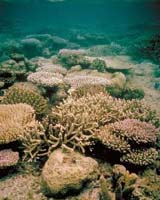
Newcastle Upon Tyne, UK (SPX) May 17, 2006 Global warming has had a more devastating effect on some of the world's finest coral reefs than previously assumed, suggests the first report to show the long-term impact of sea temperature rise on reef coral and fish communities. Large sections of coral reefs and much of the marine life they support may be wiped out for good, say the international team of researchers, who surveyed 21 sites and over 50,000 square metres of coral reefs in the inner islands of the Seychelles in 1994 and 2005. Their report is the first to show the long-term impact of the 1998 event where global warming caused Indian Ocean surface temperatures to increase to unprecedented and sustained levels, killing off (or 'bleaching') more than 90 per cent of the inner Seychelles coral. The team, led by the University of Newcastle upon Tyne, and which comprises researchers from the UK, Australia and the Seychelles, publishes its findings today, Monday May 15, in the Proceedings of the National Academy of Sciences. The research showed that, while the 1998 event was devastating in the short term, the main long-term impacts are down to the damaged reefs being largely unable to reseed and recover. Many simply collapsed into rubble which became covered by unsightly algae. The collapse of the reefs removed food and shelter from predators for a large and diverse amount of marine life - in 2005 average coral cover in the area surveyed was just 7.5 per cent. The survey showed that four fish species (a type of butterfly fish, two types of wrasses and a type of damsel fish) are possibly already locally extinct, and six species are at critically low levels (a type of file fish, three types of butterfly fish and two damsel fish), although their decline probably started to happen soon after 1998. The survey also revealed that species diversity of the fish community had decreased by 50 per cent in the heavily impacted sites. Reduced biodiversity results in a more fragile and less stable ecosystem. Smaller fish have reduced in number more quickly than larger species but their decreased availability has started to have a more lasting effect on the food chain, and this effect is likely to be amplified as time goes on. Moreover, the observed decrease in herbivorous fish is a key concern as they control algal spread. Researchers speculate that the reefs' inability to reseed is down to their relative isolation. A lack of nearby reefs to provide larvae which could settle and grow into new coral structures and the absence of favourable sea currents to transport the larvae could be largely to blame. Yet while a bleak picture is painted in the inner islands of the Seychelles, the survey area, from a diving perspective the outer carbonate islands still offer healthy coral reefs. Early results from diver tourist surveys in the inner islands suggest that diver satisfaction is high with granite reefs, wrecks and whale sharks. Lead researcher Nick Graham, of Newcastle University's School of Marine Science and Technology, said: "We have shown there has been very little recovery in the reef system of the inner Seychelles islands for seven years after the 1998 coral bleaching event. "Reefs can sometimes recover after disturbances, but we have shown that after severe bleaching events, collapse in the physical structure of the reef results in profound impacts on other organisms in the ecosystem and greatly impedes the likelihood of recovery. "Unfortunately it may be too late to save many of these reefs but this research shows the importance of countries tackling greenhouse gas emissions and trying to reduce global warming and its effect on some of the world's finest and most diverse wildlife."
Six Facts About Coral Reefs
Community Email This Article Comment On This Article Related Links University of Newcastle upon Tyne International Coral Reef Information Network Climate Science News - Modeling, Mitigation Adaptation
 Coral Reef Reveals History Of Fickle Weather In The Central Pacific
 Auckland, New Zealand (SPX) May 17, 2006
Close examination of coral reef reveals that when the rest of the world was experiencing warm weather, the Pacific was cold. And during a period of cold weather elsewhere in the world, the Pacific was warm and stormy |
|
|

| The content herein, unless otherwise known to be public domain, are Copyright 1995-2006 - SpaceDaily.AFP and UPI Wire Stories are copyright Agence France-Presse and United Press International. ESA PortalReports are copyright European Space Agency. All NASA sourced material is public domain. Additionalcopyrights may apply in whole or part to other bona fide parties. Advertising does not imply endorsement,agreement or approval of any opinions, statements or information provided by SpaceDaily on any Web page published or hosted by SpaceDaily. Privacy Statement |